
Precious Pop Pearls: The Story Behind Bad English – “Time Stood Still”
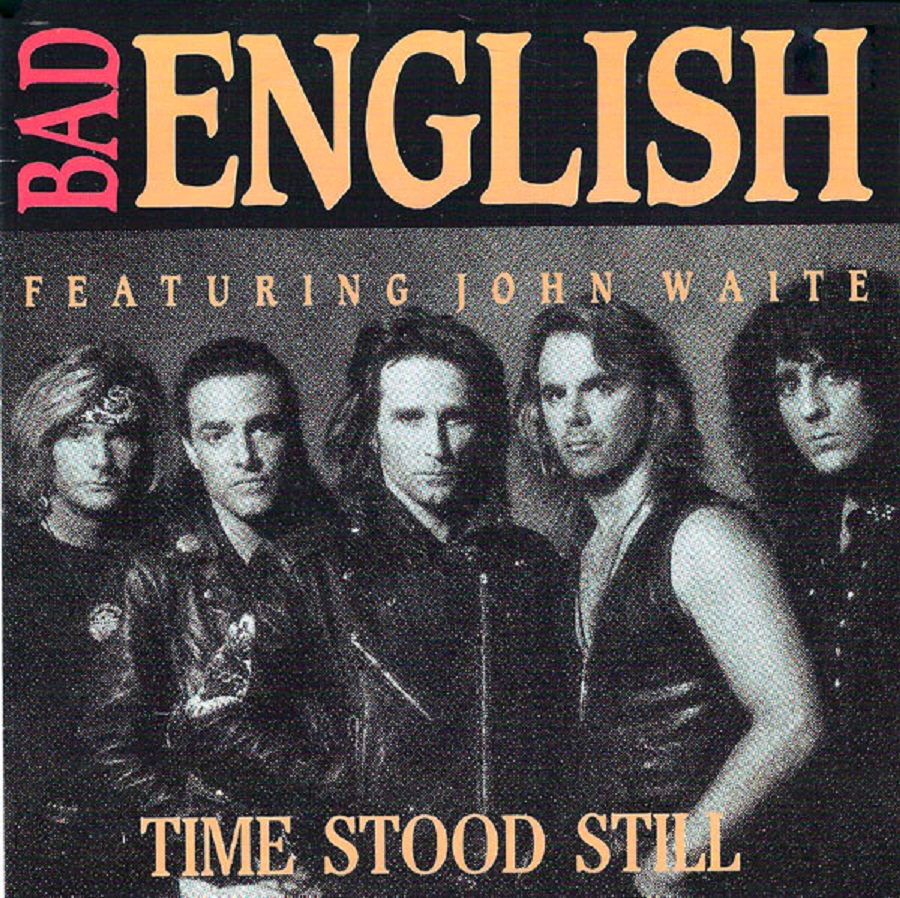
Sometimes a song gets a second life at a time when the band that made it has already become part of music history. “Time Stood Still” by Bad English is one such song. The melancholic rock ballad was released in 1991, when the group put out its second album and its future was already uncertain. In the Netherlands, the song nevertheless went on to become a major hit in early 1992. The title sounds like a romantic promise, but behind the timeless melody also lies the story of a supergroup that fell apart at the crossroads of two musical eras.
Bad English
Bad English was formed in 1988 in Los Angeles, bringing together musicians who had already made their mark. Singer John Waite and bassist Ricky Phillips came from The Babys, the British rock band that enjoyed success with melodic hard rock in the late seventies and early eighties. Keyboardist Jonathan Cain had also played with The Babys before joining Journey. Following Journey’s temporary hiatus in 1987, Cain formed a new band together with guitarist Neal Schon. The arrival of Waite and Phillips brought their old musical connection back to life. Drummer Deen Castronovo completed the line-up.
The name Bad English was a nod to a technique in billiards, but the music was anything but a game. The group combined the powerful guitars of hard rock with the sweeping melodies and emotional choruses capable of filling arenas. In the late eighties, this was a successful formula. Glam metal, AOR and stadium rock dominated radio and MTV, and bands such as Bon Jovi, Def Leppard and Journey proved that a powerful ballad could reach a rock audience just as effectively as a hard-hitting track.
The self-titled debut album from 1989 immediately delivered a major hit for Bad English. “When I See You Smile”, written by Diane Warren, reached number one on the American Billboard Hot 100. “Price of Love” also performed well in the United States. The album went platinum and confirmed that the group was more than just a collection of familiar names. The combination of Waite’s lived-in voice, Schon’s melodic guitar playing and Cain’s keyboards gave the band a distinctive sound.
Time Stood Still
By the time Bad English released “Backlash” in 1991, the musical climate was changing. Grunge and alternative rock were beginning to displace the glossy stadium productions of the previous decade. The single “Time Stood Still”, written by John Waite, Jesse Harms and Ricky Phillips, stayed true to the classic power ballad, but did so with a restraint that set the song apart from the bombast often associated with the genre.
The song opens with controlled, melodic accompaniment, leaving most of the space to Waite. His voice sounds both powerful and vulnerable: not like a singer making a grand gesture, but like someone trying to hold on to a moment that is already slipping away. The lyrics revolve around the experience of time seeming to stand still when love or memory takes over everything. As the song progresses, the guitars and keyboards gradually build the tension without completely abandoning the intimacy of the opening.
In the United States, “Time Stood Still” did not become a major hit. In the Netherlands, things were different. The single entered the charts in early 1992 and reached number seven in the Dutch Top 40. This made it Bad English’s biggest Dutch hit. In the Dutch Single Top 100, the song peaked at number 19. Its success came at a remarkable moment: the band had already split up, and no music video was made. The song therefore found its audience mainly through radio and the strength of the recording itself.
Bert Heerink
A Dutch adaptation of “Time Stood Still” appeared in 1995, when Bert Heerink recorded the song under the title “Doe wat je wil”. By then, Heerink had already established a solid reputation as a rock singer, notably as the frontman of the hard rock band Vandenberg, with whom he had also gained international recognition through their hit “Burning Heart”. After his time with Vandenberg, he continued to develop as a solo artist, increasingly making room for Dutch-language music alongside his English-language repertoire.
With “Doe wat je wil”, Heerink chose a recognisable melody from the American melodic rock repertoire, but gave the composition its own identity by translating and adapting the lyrics into Dutch. The emotional foundation of the original remained intact, while the Dutch version brought the story closer to the audience Heerink reached with his solo work. The combination of a powerful singing voice, a familiar melody and an accessible arrangement fitted well with his musical background. The result was not a literal reproduction of Bad English’s version, but an adaptation in which the original composition acquired a different cultural and linguistic context. In this way, “Time Stood Still” was given a second life in the Netherlands, several years after its original release, once again demonstrating how a strong melody cannot be confined by language or national borders.
Backlash
“Time Stood Still” appears on “Backlash”, Bad English’s second and final studio album, released in 1991. In some respects, the record sounds heavier and less polished than the debut. The band tried to retain its melodic foundations while also placing greater emphasis on guitars and a more direct rock approach.
The album reached no higher than number 72 on the American Billboard 200, a clear decline compared with the debut, which reached number 21. Internationally, too, its success was more modest. In the Netherlands, “Backlash” reached number 42 in the Album Top 100. The single “Straight to Your Heart” had already been released in the Netherlands and reached number 31 in the Top 40, but the album produced no new American Top 40 hit.
The disappointing reception was not the only reason for the group’s demise. Within Bad English, there were differing ideas about the musical direction. Schon and Cain wanted to move forward, while Waite wanted to place greater emphasis on songs and melody. The changing music industry also made things more difficult for a band so closely associated with the sound of the eighties. Shortly after the release of “Backlash”, Bad English broke up.
When I See You Smile
Anyone who primarily knows Bad English through “Time Stood Still” will hear the other side of the band in “When I See You Smile”. The 1989 single is a textbook example of the big, romantic rock ballad of that era. The piano and keyboards provide a gentle foundation, after which the guitars and drums lift the chorus to stadium proportions. John Waite sings with an open, almost pleading intensity, while the melody is built for immediate singalong appeal.
The song was written by Diane Warren, one of the most successful songwriters of her generation. Her work for artists across a wide range of genres demonstrated how a strong melody and a clear emotional starting point could make a song widely accessible. “When I See You Smile” reached number one on the Billboard Hot 100 in November 1989 and also became a success outside the United States.
The comparison with “Time Stood Still” makes it clear how Bad English developed its sound. Both songs revolve around love and vulnerability, but whereas “When I See You Smile” presents the emotion on a grand and triumphant scale, “Time Stood Still” sounds more like a reflection. One song celebrates the moment, the other tries to hold on to it.
Bad English existed for only a few years, but the band managed to bring together the melodic hard rock of the eighties in a convincing way. “Time Stood Still” appeared at a time when that style was losing its dominant position, and precisely because of that, the song carries something of a farewell within it. The recording does not sound like an attempt to save an era, but like a final reminder of what that music could mean.
The fact that the single nevertheless became a major hit in the Netherlands underlines how songs sometimes follow their own path. The band had disappeared, but the voice, the melody and the feeling remained. In “Time Stood Still”, time does not actually stand still. It is the music that preserves a moment, long after the circumstances in which it was created have changed.


