
Precious Pop Pearls: The Story Behind Righeira – “Vamos a La Playa”
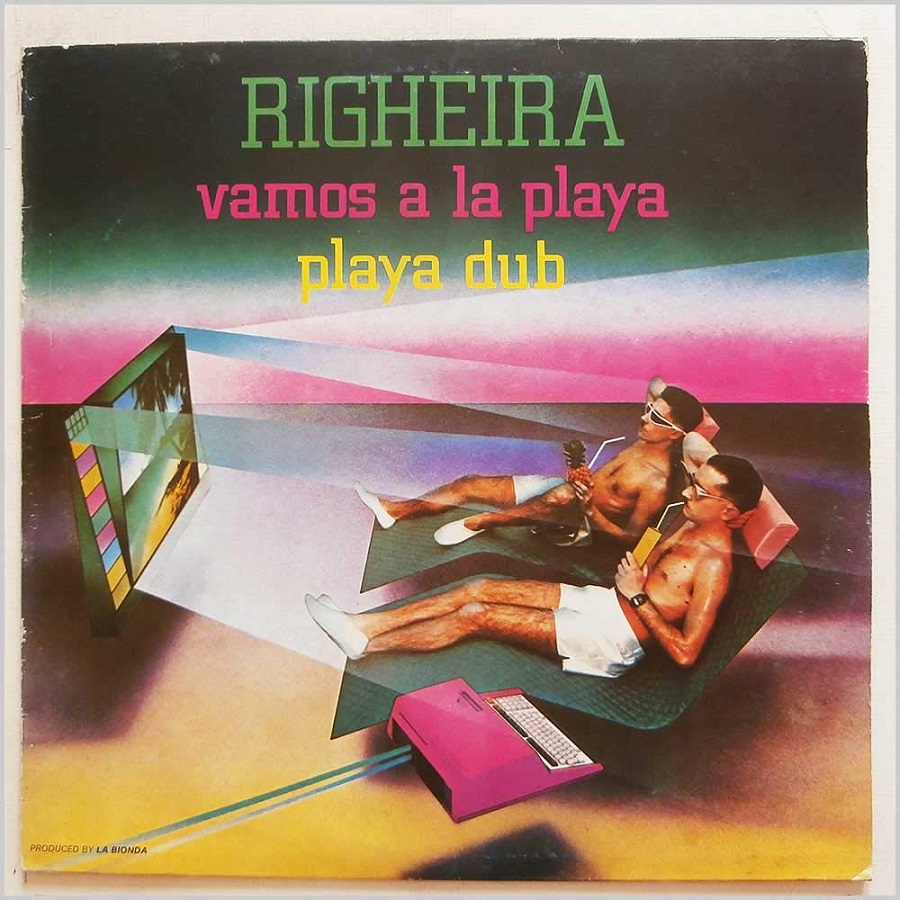
Under the surface of the most cheerful summer hit of 1983 lies one of the most cynical lyrics ever to reach the European charts. While millions of people danced to the catchy chorus of ‘Vamos a La Playa’, they were actually singing along to a song about nuclear apocalypse. This contrast between form and content makes the track one of the most intriguing paradoxes in pop music history, a story about two Italian students who defined an era with synthesisers and a dark vision of the future.
Righeira
The history of Righeira did not begin in a recording studio, but in the classrooms of the Albert Einstein Liceo Scientifico in the Barriera di Milano district of Turin. Here, Stefano Righi, born on 9 September 1960, and Stefano Rota, born on 1 October 1961, met in the late 1970s. Both young men were fascinated by the new electronic sounds conquering the music world, but had no classical musical training. What they did have was a keen eye for design, film, and the visual side of pop culture.
In 1981, Righi and Rota decided to reinvent themselves. They changed their names to Johnson Righeira and Michael Righeira, deriving the surname from a funny Brazilian-Portuguese pronunciation of Righi’s own name during a school football match. The two no longer called themselves friends, but ‘musical brothers’, an artistic construct that would define their entire image. It was more than a gimmick; it was a conscious effort to distance themselves from the traditional Italian artist image.
The duo lacked the technical knowledge to realise their vision. They were more interested in the concept of music than in making it. This changed in 1982 when they met the La Bionda brothers, Carmelo and Michelangelo, two producers from Milan who had experienced the Italian disco revolution in the late 1970s. La Bionda initially wanted Righeira to become TV show hosts due to their appearance, but the duo refused. They wanted to make their own music. La Bionda saw potential in their anarchic energy and signed a production contract until 1987.
The collaboration proved fruitful. While Righeira provided the concepts and lyrics, La Bionda handled the sonic realisation with advanced equipment such as the Fairlight CMI sampler. The result was a sound both alienating and accessible, characterised by tight electronic rhythms and almost robotic precision.
Vamos a La Playa
On New Year’s Eve 1981, Righi visited a music studio in Florence with some friends. While experimenting with a keyboard, he came up with the idea for ‘Vamos a La Playa’. The melody was inspired by the 1960s, and Righi wanted to create a beach song with a post-apocalyptic and electronic undertone. The chorus came to him spontaneously, a simple Spanish phrase anyone could sing.
But the lyrics Righi wrote were far from innocent. In Spanish, the song describes a visit to the beach after a nuclear bomb has exploded. Radioactive radiation colours the sky blue, radioactive wind blows through the hair, and the sea is finally clean, no longer polluted with stinking fish, but glowing with fluorescent radiation. It is a grim satire of the nuclear threat of the 1980s, wrapped in a cheerful dance track.
The recordings took place in August and September 1983 at Weryton Studios in Munich. La Bionda transformed Righi’s keyboard demo into a fully produced Italo disco track, complete with electronic drums, layered synthesisers, and tight production. The song was released in June 1983, four months before the debut album appeared.
The success was phenomenal. In Italy, ‘Vamos a La Playa’ reached number one and stayed there for seven weeks, from 20 August to 1 October 1983. In Switzerland, it was number one for two weeks. In the Netherlands, it peaked at number two in the Dutch Top 40, in Belgium also at number two in the Ultratop, and in Germany at number three. The song sold over three million copies worldwide. Only in the United Kingdom was the success modest, reaching number 53, illustrating how Italo disco largely bypassed the British mainstream.
The music video contributed to Righeira’s postmodern image. Since both men had just been called up for military service, they sent storyboards to a director who made an animated video using rotoscope techniques. The result was a futuristic clip with robot glasses, grid backgrounds, and dancing figures that perfectly embodied Italian postmodernism. The clip became an icon of the era.
Critics have described the track as one of the most cynical summer songs ever made. Journalist Gunter van Assche called it a miracle that this melancholic vision of fear became a worldwide hit. Emmanuelle Veil described the lyrics as biting, while Benjamin König called the song committed because it was not just about sunbathing, but about the end of the nuclear world.
Lou Bega
Thirty years after the original release, ‘Vamos a La Playa’ found a new incarnation in the hands of Lou Bega, the German singer who became world-famous in the early 2000s with his version of ‘Mambo No. 5’. Born David Lubega Balemezi on 13 April 1975 in Munich, with an Italian mother from Sicily and a Ugandan father, Bega grew up with a natural affinity for diverse musical styles.
In 2013, Lou Bega released the album ‘A Little Bit of 80s’, a tribute to the decade that shaped his musical formation. The album included thirteen covers of 1980s classics, including ‘Give It Up’, ‘Smooth Operator’, ‘Physical’, and, of course ‘Vamos a La Playa’. For Bega, who called himself a child of the 1980s, it was a chance to honour the joy of life and the fusion of musical styles that characterised that era.
Bega’s version of ‘Vamos a La Playa’ lasted 3 minutes and 15 seconds and had a Latin flavour that suited his musical identity. While the original relied on tight Italo disco synthesisers, Bega added trumpets, mambo rhythms, and warmer production. It retained the catchy chorus but transformed the apocalyptic undertone into an exuberant party mood. The dark irony of the original gave way to pure entertainment value.
The Album Righeira
Righeira’s eponymous debut album was released on 28 September 1983 on the CGD label. Initially, it was planned to release the album just before Christmas, but the success of ‘Vamos a La Playa’ and ‘No Tengo Dinero’ made an earlier release necessary. The album contained eight tracks, six of which were written by Johnson Righeira.
The production took place in Munich at Weryton Studios, with sound engineers Berthold Weindorf and Ben Fenner. La Bionda used advanced technology for the time, including the Fairlight CMI sampler and Roland MC-8 Microcomposer. The result was an album that sounded as if it came from the future, with a sound both distant and hypnotic.
Critics noted that Righeira distinguished itself from other Italo disco acts through their thematic choices. While most disco songs were about love, sex, or partying, Stefano Righi sang about nuclear destruction, government surveillance, and suffocating hypermodernism. Tracks like ‘Jazz Musik’, ‘Gli parlerò di te’, and ‘Kon Tiki’ were as accessible as they were conceptually challenging. The duo deliberately created music that felt uncomfortable, forcing listeners to adapt to a different groove.
The album fit perfectly into the 1983 Italo disco scene, a year considered a breakthrough for the genre. Labels like Discomagic Records released more than thirty singles that year, and the term Italo disco became widely known outside Italy thanks to compilations from the German ZYX label. Artists such as Ryan Paris with ‘Dolce Vita’ (written by Gazebo), Savage, My Mine, and Fun Fun all debuted the same year, making 1983 a golden period for European electronic dance music.
What was special about Righeira was their refusal to conform to conventions. Their album cover, designed by Atipiqa, radiated a futuristic aesthetic that matched their musical vision. The photos, taken at the Martano Art Gallery by Photostudio 2, showed two men who looked like they came from a science fiction movie, complete with avant-garde clothing and poses.
No Tengo Dinero
While ‘Vamos a La Playa’ dealt with nuclear destruction, Righeira’s second track focused on another form of exclusion. ‘No Tengo Dinero’, released in the autumn of 1983, literally means ‘I have no money’ and describes the frustration of someone being excluded from modern consumer society. It was again social commentary wrapped in a catchy dance track, a strategy that would make Righeira masters of Italo disco.
The song was written by Stefano Rota, also known as Michael Righeira, together with the La Bionda brothers Carmelo and Michelangelo. Like ‘Vamos a La Playa’, they chose Spanish lyrics, which was still considered an unusual combination with electronic pop music at the time. The lyrics describe how modern luxury is accessible only to the rich. In the highest part of the city, the wealthy feed on images and relays, a reference to the superficiality of the emerging 1980s media culture.
Musically, ‘No Tengo Dinero’ followed the same formula as the debut, with tight electronic drums, layered synthesisers, and almost robotic vocal production. The La Bionda brothers again used their advanced studio equipment in Munich to create a sound both futuristic and danceable. The official extended version lasted 5 minutes and 31 seconds, while the regular version ran 3 minutes and 13 seconds.
Although ‘No Tengo Dinero’ did not match the phenomenal success of ‘Vamos a La Playa’, it still became a substantial hit. In Germany, it reached number twelve in the charts. In Italy, it peaked at number ten in the Musica e dischi chart, and also reached tenth position in the Netherlands. The single proved that Righeira were not one-hit wonders, but artists with a consistent vision capable of scoring multiple hits.
An animated music video was also made for this track by director Pierluigi de Mas, who was also responsible for the clips of ‘Vamos a La Playa’ and ‘Luciano Serra pilota’. The animation technique was still relatively unusual in music videos at the time, but perfectly suited Righeira’s futuristic image. The rotoscope technique allowed the characteristic robot glasses and geometric backgrounds that defined the duo’s postmodern aesthetic.
Righeira remained active until their first break-up in 1992, after releasing the album ‘Uno, Zero, Centomila’. They reunited in 1999 and made new versions of their classics, including a reworked ‘Vamos a La Playa’ in 2001. Their fourth album, ‘Mondovisione’ appeared in 2007, after which they officially split in 2016. The relationship between Righi and Rota had deteriorated, and both went their separate ways. Johnson Righeira remained active as a solo artist, founded his own label Kottolengo Recordings, and still performs regularly. He does about 40 to 50 shows per year, performing Righeira classics.


Related Posts
-
 Precious Pop Pearls: The Story Behind Midnight Oil – “Beds Are Burning”
-
 Precious Pop Pearls: The Story Behind The Weather Girls – “It’s Raining Men”
-
 Precious Pop Pearls: The Story Behind The S.O.S. Band – “Just Be Good To Me”
-
 Precious Pop Pearls: The Story Behind Peter Schilling – “Major Tom (Coming Home)”