
Precious Pop Pearls: The Story Behind Paul Hardcastle – “19”
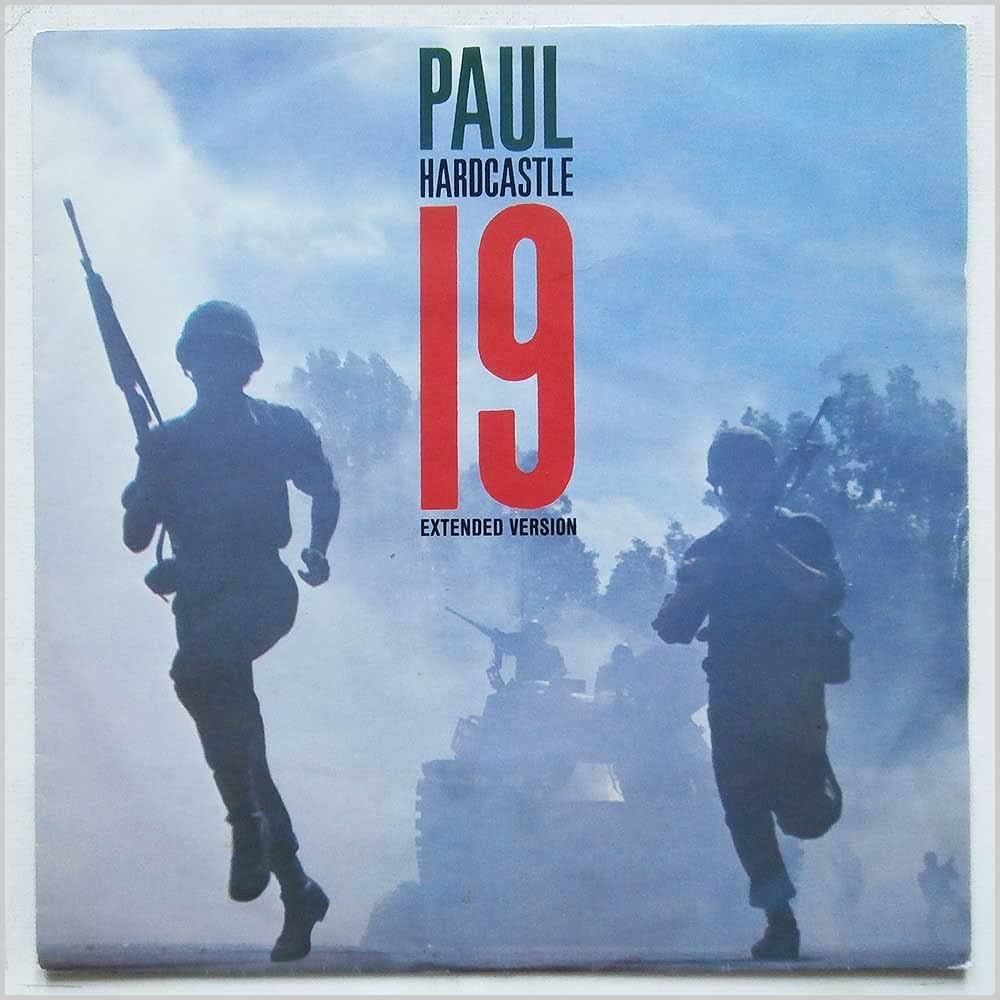
There are songs you recognise immediately from the very first second of sound, before a single note has even been played. Paul Hardcastle’s stuttering “n n n n nineteen” is one such moment. A simple stutter, born from a technical limitation of an early sampler, grew into one of the most recognisable opening lines in pop history. Behind that stutter lies a story about war, technology and chance that is much bigger than the three minutes the song lasts. This is the story of a British musician who conquered the charts of almost the entire world in 1985 with a documentary, a sampler and a good sense of rhythm.
Paul Hardcastle
Paul Louis Hardcastle was born on 10 December 1957 in Kensington, London. He grew up in a musical environment and developed an early fascination with electronic sounds and rhythms, something that was still a niche interest in the 1970s. His first steps in the music industry came in 1981 as keyboard player of the British soul band Direct Drive. Soon afterwards, in 1982, he left together with singer Derek Green to form a new duo under the name First Light. That project produced a few modest hits in the British charts, but lasted only two years before splitting up.
After the split, Hardcastle chose a solo career. His first step in that direction was a cover of a song by the American electro-funk duo D Train, a record that had deeply impressed him in a club because of its energy and production. That synth-funk direction proved to be a golden move. His fifth single as a solo artist brought him his international breakthrough: the song reached number two on the American dance chart and sold more than half a million copies on twelve-inch vinyl. That achievement attracted the attention of record company Chrysalis, where a young A&R man was looking for new electronic talent. That meeting would eventually lead to the song that made Hardcastle world-famous.
Hardcastle remained active in music after his big hit, as a producer, remixer and later also as a radio presenter. He married in 1985 and had three children, two of whom later went into the music industry themselves as a producer and a singer.
19
The inspiration for “19” came after Hardcastle recorded an American television documentary on videotape one evening. The documentary was about the consequences of post-traumatic stress disorder among Vietnam veterans and contained archive footage, news fragments and the voice of a well-known American narrator. Hardcastle sampled that voice and incorporated fragments of the documentary into an electronic rhythm, inspired by the early hip-hop productions using the drum machine that had made waves in the early 1980s.
The title refers to the claim in the documentary that the average age of an American combat soldier in Vietnam was nineteen, compared with twenty-six during the Second World War. That claim was later questioned by historians, but at the time the song did give the war a shocking and human face, at a moment when electronic dance music rarely carried a political message.
The result hit like a bombshell. “19” reached number one in the British charts and stayed there for five weeks. The song also reached the top in numerous other countries, including Germany, Sweden and the Netherlands. In the United States, the record reached number fifteen in the pop charts, while it topped the dance chart. To further increase its international success, Hardcastle had special versions recorded in which well-known newsreaders from France, Spain, Germany and Japan spoke the spoken text in their own language. Partly as a result, “19” became the best-selling single of 1985 in thirteen countries, an achievement that was rewarded with a prestigious music award for best-selling single of that year.
Musically, “19” fits seamlessly into the electronic climate of 1985, a year in which synthesisers and drum machines dominated the charts. While bands such as Depeche Mode, Yazoo and Bronski Beat explored the darker, melancholic side of synthpop and Gary Numan had popularised the cold, robotic variant, Hardcastle opted for a more cheerful, more dance-oriented electro sound, with influences from early American hip-hop. At the same time, 1985 was also the year in which house music began to emerge in Chicago and Detroit, putting “19” precisely at the crossroads between new wave, electro and the first precursors of house.
The success did not come without controversy. A well-known British progressive rock musician believed that a melodic line in “19” strongly resembled a passage from his famous concept album from the 1970s. A settlement followed and his name was subsequently added to the credits of the song. The American television network from which the documentary originated also went to court because the samples had been used without permission.
The Commentators
The most popular proof of how big “19” was in Britain at the time came in the form of a parody. In that same year, 1985, British impressionist and comedian Rory Bremner, performing under the one-off name The Commentators, recorded a song entitled “N N Nineteen Not Out”. Musically, it was an almost identical cover of “19”, but the lyrics were completely transformed into a cricket story. Bremner imitated well-known British cricket commentators who reported with growing despair on England’s poor performances during the 1984 Test series against the West Indies, in which the English captain scored an average of nineteen runs.
What is remarkable about this cover is that Hardcastle himself was closely involved. Although his record company advised him against participating in a parody of his own major hit, he co-wrote the song and even served as producer. The cover became a hit in its own right and reached number thirteen in the British charts, where it remained for seven weeks. It is a rare example of an artist allowing his own greatest success to be parodied and actively participating in it, which says a great deal about the way “19” was already regarded at the time as a cultural phenomenon rather than merely a hit single.
Paul Hardcastle
“19” was released as the first single from Hardcastle’s self-titled album, his fourth studio album, released in 1985 on Chrysalis Records. In addition to the title track, the album contained other electronic tracks produced by Hardcastle, including the later single “Just for Money”. A notable feature of the album is the series of guest contributions: alongside female singers and backing vocalists, renowned actors also contributed by recording spoken voice fragments for various tracks, a technique Hardcastle had also used on “19” with the sampled documentary voice.
The album reached a modest number fifty-three in the United Kingdom album charts, which stands in stark contrast to the enormous success of the single. This was not unusual for the era: many synthpop and electro productions from the mid-1980s relied primarily on the strength of one exceptional single, while the accompanying album had less appeal to the general public. Nevertheless, the album confirmed Hardcastle’s status as a versatile producer who went beyond making a single hit, and it laid the foundation for his later work as a remixer and composer for, among other things, film and television.
Rain Forest
Even before “19” conquered the world, Hardcastle had already achieved considerable success with the single “Rain Forest”. That song, built around the same synth-funk aesthetic that would characterise his later work, reached number two on the American dance chart and sold more than half a million copies on twelve-inch vinyl, at the time the favourite format of clubs and DJs. Whereas “19” relied mainly on spoken samples and a political message, “Rain Forest” revolved around a rhythmic, layered sound of synthesisers intended to evoke the atmosphere of a tropical rainforest.
It was precisely this song that put Hardcastle on the radar of the record company that would eventually sign him and pave the way for “19”. Without the success of “Rain Forest” in the American club scene, it is questionable whether Hardcastle would ever have been given the opportunity to release his Vietnam project on a major label. The song also shows that Hardcastle had already developed a recognisable signature before his worldwide hit: tight electronic rhythms, layered synthesiser parts and a sense of melody that went beyond the average dance track of the time.
Forty years after its release, “19” still sounds like a time capsule of 1985, but one that has remained surprisingly relevant. The combination of spoken word, sampling and a socially charged subject was groundbreaking at the time and would later be imitated by countless artists across a wide range of genres. Hardcastle himself has repeatedly released the song in new mixes over the years, including reissues that, decades after its release, still find their way to new generations of listeners.
What ultimately makes “19” so remarkable is that it was never only about the technology. The stuttering voice, the cold synthesisers and the documentary fragments served a greater purpose: to tell a human story about young soldiers who were sent to the front too soon. The fact that a dance track with such a heavy message could top the charts worldwide says a great deal about the power of pop music to make serious subjects accessible without losing their gravity. It is precisely that combination of innovation, chance and meaning that makes “19” a lasting gem in the history of pop music.


