
Precious Pop Pearls: The Story Behind Los Bravos – “Black is Back”
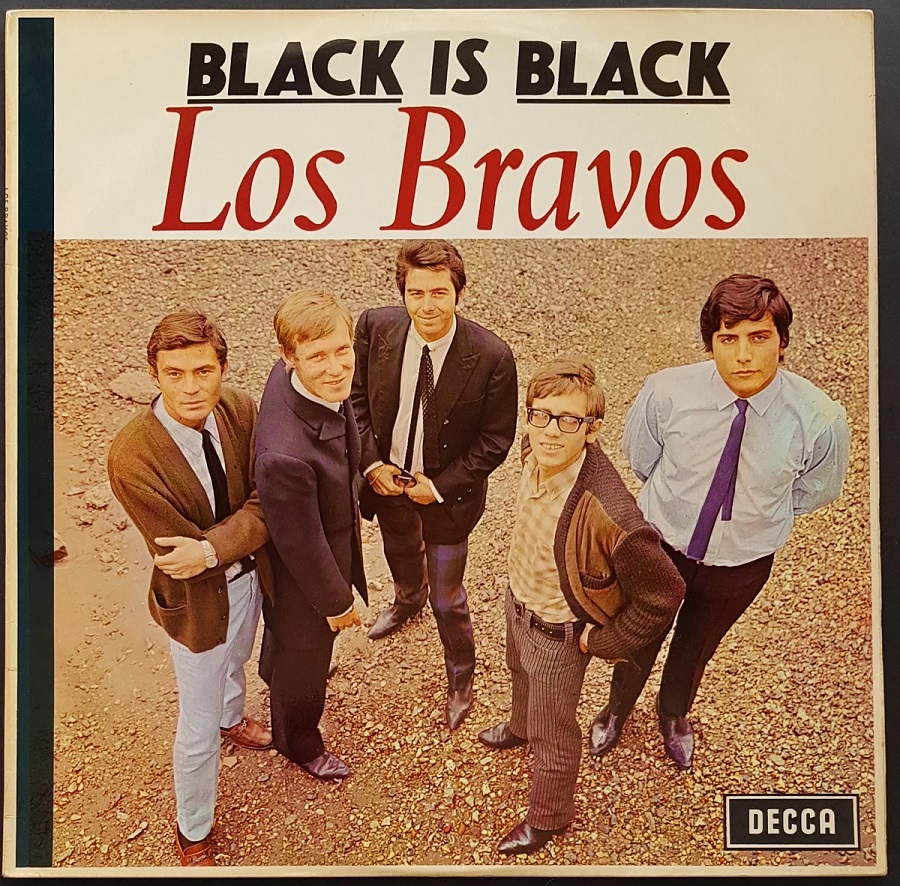
There are songs that sound so obvious that you almost forget how unlikely their creation actually was. “Black Is Black” is one such song. It was recorded in 1966 by a group of young Spanish musicians with a German singer, written by three relatively unknown British songwriters and produced in London by a man who until then had mainly worked behind the scenes. The result was one of the biggest international hits of that year and the first time that a Spanish rock band broke through worldwide. The story behind this song is about chance, ambition and an era in which pop music began to cross boundaries that had previously seemed unimaginable.
Los Bravos
Los Bravos was formed in 1965 in Madrid from a merger of two existing groups, Los Sonor and the group Mike and the Runaways. Four members, bassist Miguel Vicens Danus, guitarist Tony Martinez, organist Manuel Fernandez and drummer Pablo Sanllehi, had already played together in Los Sonor. What made the new band special was the arrival of singer Michael Kogel, a German-born singer who would later become known under the stage name Mike Kennedy. His voice had an international sound that was unusual in the Spanish music scene, and together with the rest of the band he consciously decided to sing in English in order to break through outside Spain.
That was a bold choice. At the beginning of the sixties, almost all Spanish pop acts sang in Spanish and their reach remained limited to the Iberian Peninsula and Latin America. Los Bravos chose a different path. After signing with the Spanish branch of Decca Records, the band travelled to England to work with producer Ivor Raymonde, someone who had already gained experience with artists such as Marty Wilde, Billy Fury and Dave Berry. That collaboration would prove to be the key to the success that followed.
Black Is Black
“Black Is Black” was written by the British songwriting team Michelle Grainger, Tony Hayes and Steve Wadey and appeared in 1966 as Los Bravos’ debut single for Decca. The song reached number two in the United Kingdom, number four in the United States and even number one in Canada. In their home country, the success was even greater, with the song topping the Spanish charts from November 1966 until the end of January 1967. This made Los Bravos the first Spanish rock band with an international hit, something that was seen as a minor miracle at the time.
The commercial success did not come immediately, either. In the United States, the song first appeared on the Billboard Hot 100 in August 1966, at the modest position of number one hundred, before steadily climbing to number four. That gradual success fits the picture of a record that initially had to find its feet on American radio, but once picked up, could no longer be stopped.
The comparison with other music from that period says a great deal about how remarkable this was. 1966 was the year of the British invasion in full force, with bands such as The Rolling Stones, The Beatles and The Kinks dominating the charts. Coincidentally, The Rolling Stones released a song with a similar title that same year, “Paint It Black”, which ultimately became an even bigger hit. The fact that Los Bravos, a band from a country without a significant rock tradition, could establish themselves among those established Anglo-Saxon names underlines how exceptional their breakthrough was.
Kogel’s voice was often compared at the time to that of American singer Gene Pitney, and the resemblance was so strong that some listeners at the time thought that “Black Is Black” was actually a Pitney record. The combination of a compelling melody, a tight arrangement and a singer with a unique, internationally sounding voice proved to be a winning formula. The song sold more than a million copies worldwide and remained in the charts of several countries for weeks.
Belle Epoque
Eleven years after the original, “Black Is Black” was given a surprising second life, this time in the hands of the French female trio Belle Epoque. The group, consisting of singer Evelyne Lenton and two backing singers, released a disco version of the song in 1977 that fitted surprisingly well with the tastes of the time. The disco wave was in full swing and Belle Epoque’s tight, danceable arrangement gave the composition a completely new outfit.
What makes this cover particularly remarkable is that Belle Epoque’s version achieved exactly the same chart position as the original by Los Bravos, namely number two in the British charts, and that eleven years later. The disco version also became a hit in several European countries and showed how flexible the composition was. Whereas the original was driven by guitars and a swinging rhythm from the beat era, the song was transformed in the disco version into a dancefloor filler complete with strings and a pumping bassline.
The cover appeared on Belle Epoque’s debut album, entitled “Miss Broadway”, which was released in 1977. Remarkably, “Black Is Black” appeared on that album three times, as part of a longer disco medley on the second side of the record. It is a fine example of how a strong melody can be adapted to the tastes of a new generation of listeners, and of how a producer can sometimes like a composition so much that he wants to have it return several times within the same album.
Black Is Black
Los Bravos’ eponymous debut album was also released in 1966 and was issued in different countries through different record labels, Columbia in Spain, Decca in the United Kingdom and Press Records in the United States. The tracklist differed slightly between the Spanish and British editions on the one hand and the American release on the other, something that was fairly common at the time when record companies put together international releases according to their own preferences.
The album naturally contained the title track that made the band famous worldwide, but it also provided a good picture of where the group came from, with influences from the British beat music of those years mixed with their own, slightly Mediterranean touch. In the United States, the album reached number ninety-three on the Billboard album chart, an impressive achievement for a debut album by a band that until recently had been virtually unknown outside Spain.
Bring a Little Lovin’
Where “Black Is Black” was the breakthrough, “Bring a Little Lovin'” two years later proved to be one of the few songs with which Los Bravos still made some impression internationally. The song was written by Harry Vanda and George Young of the Australian band The Easybeats and appeared in April 1968. It reached number fifty-one in the American charts and number two in Spain.
The year 1968 was a period of great sorrow for the band. Organist Manuel Fernandez lost his wife in a car accident, a tragedy that would prove fatal to him several weeks later. Shortly afterwards, singer Kogel left the group to begin a solo career under the name Mike Kennedy, which marked the end of the classic line-up of Los Bravos. Despite this difficult period, “Bring a Little Lovin'” was given a second life decades later, when the song was prominently featured in Quentin Tarantino’s film Once Upon a Time in Hollywood, introducing a new generation of listeners to the band.
Los Bravos proved that a Spanish group, singing in English, could compete in the same charts as the major British and American names of the time. The song also survived its own era, was given a second life on the dancefloor through Belle Epoque, and was even re-released as a separate dance remix in 1986. Few pop songs from the sixties can say that they have found their way into the charts in so many different ways and across so many different decades.


