
Plastic Bertrand: the greatest fraud case in Francophone pop history
“Ça Plane Pour Moi”, the punk classic from 1977 credited to the Belgian artist Plastic Bertrand, is, with eight million singles sold, one of the best-selling French-language songs of all time. It is also the centrepiece of what may well be called the longest-running and most bizarre fraud case in European pop history: half a century of lies, lawsuits, linguistic analyses and a secret the composer took to his grave.
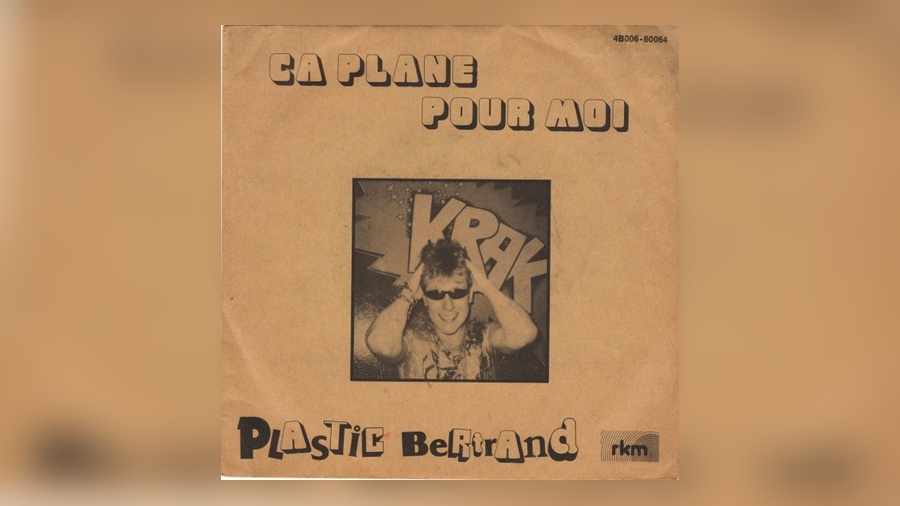
In the summer of 1977, the Walloon producer and composer Lou Deprijck, born Francis Jean Deprijck in Lessines in Hainaut, wrote the music together with lyricist Yvan Lacomblez for what would become two songs. The backing track was recorded at Studio Morgan in Brussels by session musicians Mike Butcher on guitar, John Valcke on bass and Bob Dartsch on drums, under the direction of sound engineer Phil Delire. Two completely different songs were built over that one instrumental recording: a French-language version with absurdist lyrics, and an English-language version with explicitly homosexual content. The French version became “Ça Plane Pour Moi”. The English version, “Jet Boy, Jet Girl”, went to British singer Alan Ward, who performed under the name Elton Motello. Ward had come to know Belgium as a member of the glam rock band Bastard, whose guitarist Brian James would later form The Damned. His lyrics told the story of a fifteen-year-old boy in a sexual relationship with an older man. That version was released slightly earlier than the French one, but received little airplay because of its content.
“Ça Plane Pour Moi”, by contrast, shot up the charts. Number 1 in France and Switzerland, number 2 in the Netherlands and Australia, number 6 in West Germany, and number 8 in the United Kingdom. In the United States, the song reached number 47 on the Billboard Hot 100, an exceptional achievement for a French-language song. Only “Dominique” by Sœur Sourire and “Je t’aime… moi non plus” by Serge Gainsbourg and Jane Birkin had achieved that before.
Lou Deprijck was no nobody who happened to cobble together a punk record. When he wrote “Ça Plane Pour Moi” in 1977, he already had a career that swung from flop to hit. His first band, Pop’ Liberty 6, faded away without success in 1967 with the single “Je suis pop et tout à fait dingue”. But with Two Man Sound, a Latin pop formation he formed with Sylvain Vanholme of The Wallace Collection and Yvan Lacomblez, he sold millions of records. Their 1975 single “Charlie Brown” sold more than a million copies. The album “Disco Samba”, a medley of Brazilian hits including work by Jorge Ben, sold 1.4 million copies in Latin America alone.
Deprijck was a chameleon: producer, composer, singer, entertainer. He compared himself to Kid Creole and the Coconuts, and the comparison holds: the same mix of big band jazz, disco, Caribbean music and Hollywood glamour. In 1978, he scored a European hit under the name Lou & the Hollywood Bananas with “Kingston, Kingston”. In the 1980s, he launched the career of Viktor Lazlo, born Sonia Dronier, whom he met in the Brussels nightclub Le Mirano and named after a character from the film “Casablanca”. Deprijck produced two albums for her.
In short, he was a man who knew how to make hits. And who knew that you did not necessarily need the same person for the recording and for the stage. The problem: the voice on the record was not that of the man on the cover.
Roger François Jouret, born on 24 February 1954 in Brussels to a French father and a Ukrainian mother, was a drummer in the punk band Hubble Bubble when manager Bernard Schol brought him into contact with Deprijck. He was not looking for a musician; he was looking for a face. Jouret had the looks, the energy, the television appeal. Deprijck dressed him in a leather jacket with safety pins from Malcolm McLaren’s shop in London, stuck the stage name Plastic Bertrand on him, and sent him out into the world. ‘Plastic had enormous qualities’, Deprijck later admitted. ‘He danced remarkably. He spoke perfectly for television. He had incredible charisma. He was the perfect vehicle for the song.’ But the voice on “Ça Plane Pour Moi”, and according to Deprijck also on the four albums that followed between 1977 and 1981, was Deprijck’s own. Jouret was not allowed into the studio. He was, in his own words, the shop window of a product over which he had no control.
After the end of his collaboration with Deprijck in 1981, Jouret tried to build a career of his own. He presented television programmes in France, Belgium and Italy, was the star of an Italian photo story followed by millions of readers, worked with composer Vladimir Cosma on the soundtrack of “Astérix et la surprise de César”, and took part with Daniel Balavoine and Anni-Frid Lyngstad of ABBA in “Abbacadabra”, a musical fairy tale for children. In 1987, he represented Luxembourg at the Eurovision Song Contest with “Amour, Amour”. The result: 4 points, a twenty-first place out of twenty-two participants. An embarrassing failure that perfectly summed up the irony of his career: the man who had become famous with a voice that was not his own could not even put Luxembourg on the map with his own voice.
Joe Strummer of The Clash once called “Ça Plane Pour Moi” a stunningly good record that would get even someone in a coma tapping their foot. Strummer did not know he was praising the producer, not the artist.
The fraud lasted almost fifty years through a combination of legal manoeuvres, financial interests and mutual silence. In 2006, the Brussels Court of Appeal ruled, in a case brought by record company AMC against Deprijck, that Plastic Bertrand was the sole legal performer of the song. But that ruling concerned copyright issues surrounding a new version Deprijck had recorded in 2006, not the factual question of who had sung in 1977. Deprijck himself never put that question before a court.
In 2010, a linguistic analysis carried out in the context of another lawsuit revealed an uncomfortable truth. The expert analysed the 1977 vocal recording and compared it with a version Deprijck had recorded in 2006. His conclusion: the same voice. Moreover, the expert pointed to the sentence endings in the recording, which he believed could only be attributed to someone with a Picard or ch’ti accent. Jouret, born and raised in Brussels, did not have that accent. Deprijck, from Lessines in Hainaut near the French border, did.
Jouret seemed to confirm the matter shortly afterwards in an interview with a major Belgian newspaper. ‘I am willing to say that it was not my voice’, he declared, ‘but then you must also say that it was all staged by Lou Deprijck.’ According to Jouret, Deprijck had asked him to keep quiet in exchange for 0.5 per cent of the royalties, with the promise that a new version featuring Jouret’s own voice would follow. It never did. The next day, Jouret withdrew everything. He claimed he had been ironic, that he had been trapped, and threatened legal action. It was not the first time: in the 1990s, he had done the same with journalist Gilles Verlant: briefly admitting, immediately denying.
While the truth remained a Belgian Byzantine tug of war, the song led an unprecedented second, third and fourth life. It appeared in Martin Scorsese’s “The Wolf of Wall Street” as a sonic translation of unrestrained hedonism, in Danny Boyle’s “127 Hours”, in the opening scene of “Jackass 3.5”, in “Ruby Sparks”, in the Netflix series “La Casa de Papel” and in “Ozark”. Coca-Cola used it for an advertising campaign in Southeast Asia, and Pepsi for a commercial in the United States. The video game Just Dance 2019 included a cover version. The list of covers reads like a who’s who of alternative rock: Sonic Youth, Presidents of the United States of America, The Damned, Leila K, whose 1993 version reached the top 20 in six European countries, Nouvelle Vague and Vampire Weekend. It is a song that refuses to disappear, partly because it is so infectious, partly because no one quite knows what is being sung. The lyrics, written by Lacomblez, are a string of nonsensical images: a cat swallowing its tongue while drinking whisky, a night in the gutter, a flash in four colours. Deprijck once described it as the field of vision of someone on LSD.
What makes the case even more absurd is the fate of “Jet Boy, Jet Girl”. The same instrumental foundation, the same studio, the same session musicians, the same producer, but a radically different text: an explicit story about a homosexual relationship with a minor. Alan Ward wrote the lyrics, and the song was released a few weeks earlier than “Ça Plane Pour Moi” on the Belgian label Pinball, while the French version appeared on RKM. “Jet Boy, Jet Girl” became a cult classic in underground circles. The Damned recorded a cover in 1978, Captain Sensible as well, and decades later, Crocodiles and Laura Jane Grace followed. John Waters included it on his 2007 compilation “A Date with John Waters”. A radio station in Miami was fined ten thousand dollars by the FCC in 1989 for playing it. But it never became a major hit: society was not ready.
Deprijck, meanwhile, collected composer royalties from both versions, plus all covers and all sync deals. It was, as a Canadian music journalist put it, one of the most unusual dual income streams in music history.
On 19 September 2023, Lou Deprijck died at the age of 77 in a Brussels hospital from sudden sepsis. He had lived for years in Thailand, near Pattaya, where he wrote a song that became the unofficial anthem of the seaside resort. Back in Belgium, he left behind a daughter and a 26-year-old girlfriend whom he planned to marry. He had already chosen his burial place, next to the cemetery of Wannebecq near Lessines. ‘I bought that piece of land’, he once said of it. ‘Enough for a grave with a little front garden.’ Prince Laurent, who had been friends with Deprijck for years, attended the funeral in Saint Peter’s Church in Lessines, where hundreds of people came to pay their respects.
With Deprijck’s death, the only person who could say with certainty what had happened in the summer of 1977 at Studio Morgan disappeared. Jouret has since consistently maintained that he is the performer, and legally that remains his position. The 2010 linguistic analysis has never overturned the 2006 ruling of the Brussels court. The law says one thing, science suggests another, and the truth lies somewhere in a grave with a little front garden in the cemetery of Wannebecq.
“Ça Plane Pour Moi” is more than a pop song. It is a case study in the mechanics of pop music: proof that charisma, timing and three chords in A, E and D can weigh more heavily than the voice that brings them to life. It is a song sung by the wrong man, performed by the right man, and ultimately belonging to no one any more except everyone who has ever heard it in a film, a commercial or a pub on a Saturday night. In the history of Francophone pop, there is no greater deception. But perhaps that is precisely why the song fits so well with the life it describes: absurd, incoherent, and irresistibly infectious.


