
Precious Pop Pearls: The Story Behind Rupert Holmes – “Escape (The Piña Colada Song)”
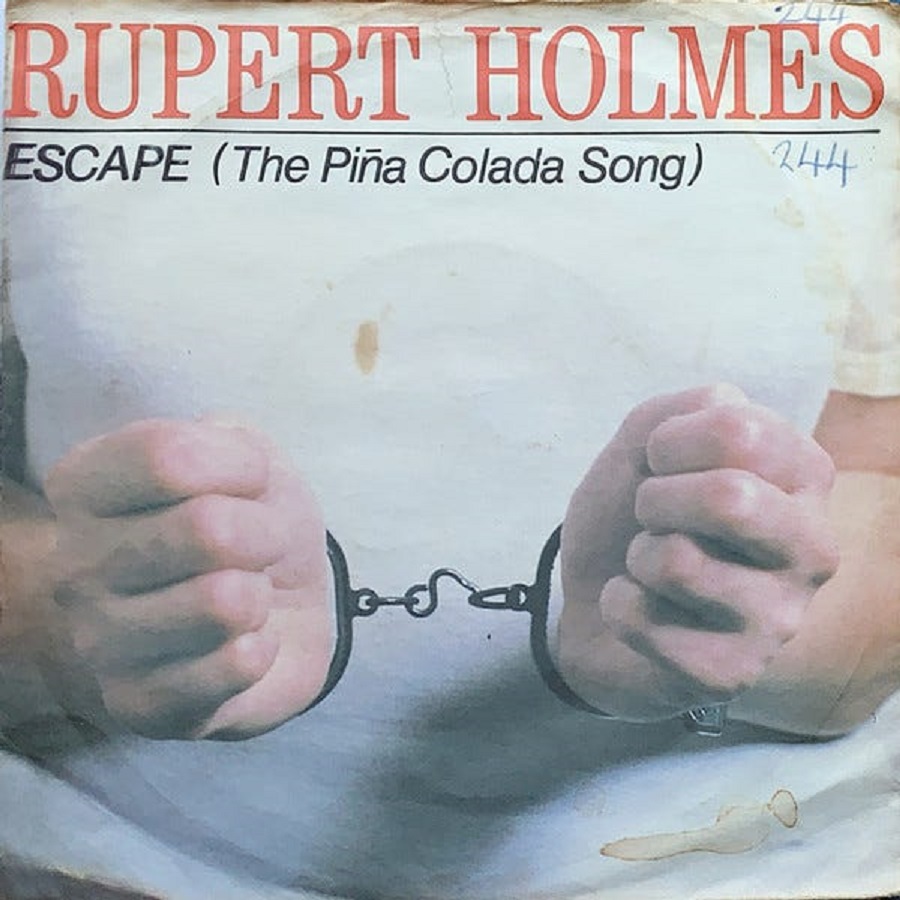
There are songs you hear once and never forget. Then there are songs you hear, find slightly annoying at first, and yet still end up singing years later as soon as the opening chords begin. Rupert Holmes’s “Escape (The Piña Colada Song)” belongs to that second category, but that takes nothing away from the beautiful, almost literary construction of the song. It was released in September 1979 and would become the very last American number one hit of the 1970s. A decade filled with musical revolutions, from punk to disco and from funk to prog rock, ended with a smooth, gently told story about a man who accidentally tries to seduce his own girlfriend through a personal advertisement. It would be difficult to imagine a more poetic way to close an era.
Rupert Holmes
Behind the name Rupert Holmes lies a remarkable life story. He was born David Goldstein on 24 February 1947 in Northwich, Cheshire, England. When he was six years old, the family moved to the state of New York, to the town of Nanuet, and young David grew up as a true New Yorker. After studying at the Manhattan School of Music, he began his career as a session musician and songwriter for others, with his work being recorded by artists such as Barbra Streisand, the Platters, the Drifters, Dolly Parton and Barry Manilow.
His first notable chart success as a songwriter was “Timothy” in 1971, a song he wrote for The Buoys that reached the Billboard Hot 100. However, his own name did not appear in the charts until 1978, when “Let’s Get Crazy Tonight” became a modest hit. During the 1970s Holmes had meanwhile released four studio albums of his own, serving as composer, lyricist, arranger and sometimes conductor. Yet the public barely noticed him. He lived comfortably as a writer for others, but fame remained out of reach.
That changed dramatically at the end of the decade with the album that would contain “Escape”. Holmes was not a young newcomer making his first groundbreaking record, but a seasoned craftsman who finally received the public recognition his talent had long deserved with his fifth album.
Escape (The Piña Colada Song)
The story behind “Escape” began one evening when Holmes was leafing through The Village Voice, the well-known New York weekly newspaper. His attention was drawn to the personal advertisements section. That became the spark for a story in three acts, three verses and three choruses, ending with a classic plot twist worthy of O. Henry. The narrator is a man who feels that his relationship has become routine. While his partner sleeps, he reads the personal advertisements and comes across a woman looking for a man who likes piña coladas, walking in the rain, love at midnight and yoga. Intrigued, he writes back and arranges to meet her at a bar called O’Malley’s. When he meets his mysterious date, she turns out to be his own partner.
Originally, the song was simply called “Escape”, and that is how it was released. The chorus originally began with the lyric “if you like Humphrey Bogart”, but Holmes decided to change it because he felt his songs already contained too many references to old films. He eventually chose the piña colada, a cocktail he personally could not stand. When records were requested in shops, customers asked for “that song about piña coladas”, and nobody knew it by the title “Escape”. The record label convinced Holmes to add the subtitle, and it became “Escape (The Piña Colada Song)”.
The recording itself also has an unusual story. Holmes sang his vocal part in a single take as a scratch track intended as a reference for guitarist Dean Bailin. He also improvised a harmony line a third above his own voice. When he returned the next day to record the “real” vocal, he could not recapture the same energy and spontaneity. In the end, that original scratch vocal became the final version. Drummer Leo Adamian was assisted by a second drummer because the rhythmic pattern of the song was too complex for one person alone.
The single was released on 17 September 1979 through Infinity Records and steadily climbed the charts. It reached number one on the Billboard Hot 100 on 22 December 1979, just before the New Year, and remained there into January 1980. This makes it the only song to hold the number one position in two consecutive years and two consecutive decades. It also reached number one in Canada, became a top three hit in Australia, reached number ten in Ireland and entered the top thirty in the United Kingdom. In the musical climate of 1979, dominated by disco, punk and the rise of what would later be known as yacht rock, “Escape” was a perfect example of the soft, narrative pop music that was widely embraced at the time. Supertramp broke through that same year with “Breakfast in America”; Christopher Cross did so with his self-titled debut album, and artists such as Kenny Rogers, Michael McDonald and Kenny Loggins dominated radio airplay. “Escape” fits seamlessly into that landscape of carefully produced, melodically strong adult-oriented music.
Jack Johnson
More than thirty years after the original recording, “Escape” found a new audience through a cover by American singer-songwriter Jack Johnson. Johnson recorded the song for the soundtrack of the 2013 film “The Secret Life of Walter Mitty”, directed by Ben Stiller. The film tells the story of a dreamer who finally turns his fantasies into reality, and Johnson’s interpretation of “Escape” fits perfectly. His characteristic acoustic approach and warm voice give the song a relaxed, summery atmosphere that strengthens the story of the original without diminishing it.
The soundtrack, released through Universal Republic Records and Brushfire Records in December 2013, featured several songs by Johnson alongside contributions from artists including Junip and Of Monsters and Men. Johnson’s cover reached a generation of listeners born after Holmes’s original release while simultaneously bringing renewed attention to the song among older fans. It is a rare case in which a film cover version does not overshadow the original but instead adds another layer of meaning to it.
Partners in Crime
“Partners in Crime”, released on 5 August 1979 through Infinity Records, is Rupert Holmes’s fifth studio album and his most commercially successful work. The album contains ten songs, all written and arranged by Holmes himself, and was recorded at Plaza Sound Studios in New York City. In addition to Holmes, guitarist Dean Bailin, bassist Frank Gravis and drummer Leo Adamian participated in the recording sessions.
The album is first and foremost a showcase for Holmes as a storyteller and arranger. The songs range from the narrative pop rock of “Escape” to ballads and more experimental compositions. “Answering Machine” discusses the role of the answering machine in daily life with an almost prophetic vision and still sounds remarkably relevant today. “The People You Never Get to Love” is one of the album’s finest ballads, allowing Holmes to display his vocal abilities in a more intimate manner.
“Partners in Crime” reached number 33 on the Billboard 200 and was certified gold in the United States. This was partly due to the success of “Escape”, but its follow-up “Him” also contributed to the album’s popularity. It is a record that may have been somewhat underestimated by critics upon release but is now appreciated decades later for its consistency and sophistication.
Him
While “Escape” was actually intended as an album filler, “Him” was always the single Holmes had envisioned as the lead release from the album. Following the unexpected success of “Escape”, “Him” was released on 7 January 1980 as the second single from “Partners in Crime”, this time through MCA Records, as the Infinity label had by then been absorbed into MCA.
The song tells the story of a man who finds a packet of cigarettes that does not belong to him and concludes that his girlfriend is cheating on him. The unknown lover remains anonymous throughout the lyrics, always referred to simply as “him”, a vague threat that forces the narrator into confrontation. Musically, “Him” is somewhat tighter and more restrained than “Escape”, featuring prominent synthesiser use and an arrangement leaning more towards the early era of 1980s pop music.
The song reached number six on the Billboard Hot 100 in March 1980 and remained there for two weeks. In the Adult Contemporary charts in both the United States and Canada, it peaked at number four. Holmes thereby proved that “Escape” had not been a one-off stroke of luck, but that he genuinely had something to offer as a narrative singer-songwriter.
The success of “Escape” has always given Rupert Holmes mixed feelings. The song made him wealthy and famous, but it also cast a shadow over the rest of his extensive career. With the financial freedom that “Escape” provided, he took the time to tackle a completely new project: a Broadway musical based on Charles Dickens’s unfinished novel “The Mystery of Edwin Drood”.
That decision proved to be a masterstroke. “The Mystery of Edwin Drood” premiered in Central Park in 1985 as part of the New York Shakespeare Festival and later moved to Broadway that same year. The musical became a major success and won five Tony Awards, including Best Musical. Holmes personally received Tony Awards for Best Book of a Musical and Best Original Score. In doing so, he became the first person to win all three Tony writing awards for a single production on his own.
His Broadway work did not stop there. He co-wrote the musical “Curtains” with the legendary duo Kander and Ebb, earning the Drama Desk Award for Outstanding Lyrics. He collaborated with Marvin Hamlisch and Steven Soderbergh, and his songs were recorded by names such as Renée Fleming and Britney Spears. Alongside his theatre work, Holmes also became an acclaimed crime novelist. His debut novel “Where the Truth Lies” was adapted into a film starring Colin Firth and Kevin Bacon, while his later novel “Murder Your Employer” became a New York Times bestseller.
“Escape (The Piña Colada Song)” will always remain his best-known work, and that is a small irony of history. The song he wrote as album filler, recorded in one spontaneous scratch vocal, that almost received a different title and that he never really considered a potential hit, ended up closing a decade and defining an entire body of work. Yet for those willing to look beyond the tropical cocktail, a rich world of compositions, theatre works, novels and songs awaits. Ultimately, the story behind “Escape” is the story of a writer who is too large to be defined by a single song, no matter how good that song may be.


