
Precious Pop Pearls: The Story Behind The Whispers – “And The Beat Goes On”
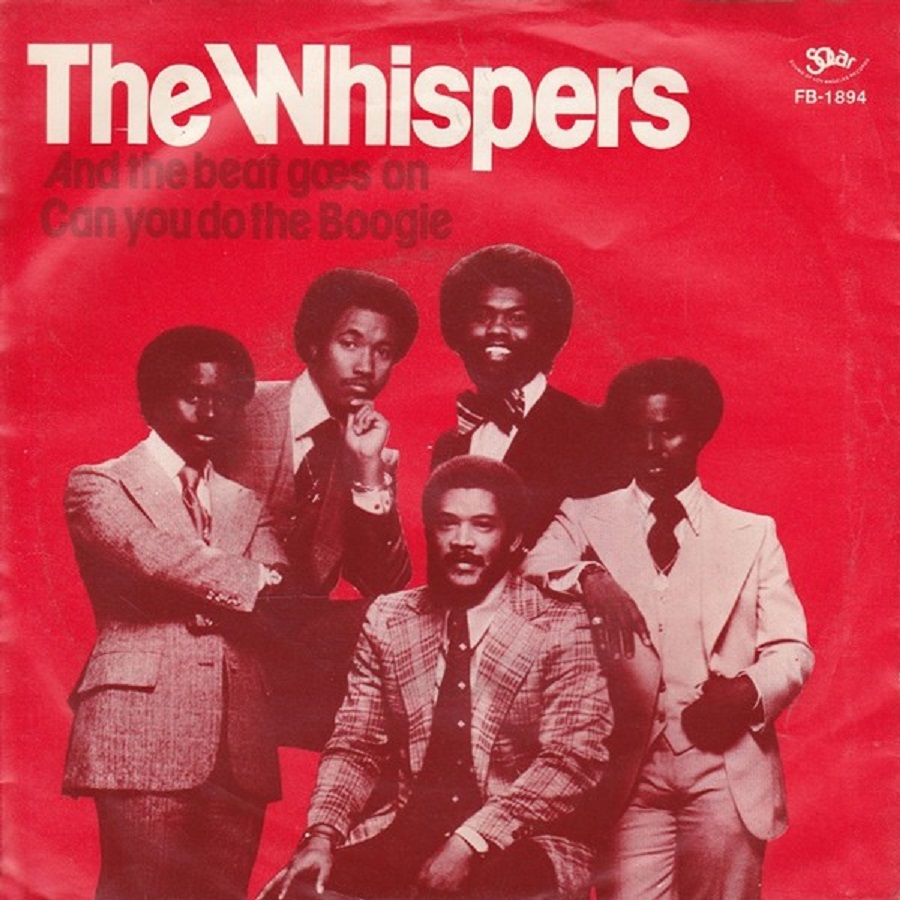
The Whispers began their journey in 1963 in the Jordan Downs housing projects in Watts, Los Angeles. Originally called the Eden Trio, after being discovered by Lou Bedell of Dore Records, they were given a fitting name that reflected their soft, whispered harmonies. The original lineup consisted of identical twin brothers Wallace Scotty and Walter Scott, along with Gordy Harmon, Marcus Hutson and Nicholas Caldwell. These Jordan High School students rehearsed obsessively, often until four in the morning, inspired by The Flamingos, The Temptations and Nat King Cole.
The Whispers
In 1966, they were invited by Sly Stone to the San Francisco Bay Area, where they grew into a respected live act. Their breakthrough, however, was delayed. Walter Scott was drafted to serve in Vietnam and only returned in 1969. Their first top 10 R&B hit came in 1970 with “Seems Like I Gotta Do Wrong”, but real success eluded them. In 1973, Leaveil Degree replaced the departed Gordy Harmon, and this lineup would remain stable for decades.
The group eventually signed with Soul Train Records, the first label of TV producer Don Cornelius and entrepreneur Dick Griffey. When Griffey founded his own SOLAR Records, The Whispers went with him. This decision would ultimately change their career. SOLAR became home to a distinctive sound: tightly produced, funky disco with crystal-clear vocals, orchestrated by in-house producer Leon Sylvers III.
And The Beat Goes On
The single reached number one on the Soul chart and number nineteen on the Billboard Hot 100, while also peaking at number two in the United Kingdom. For a group that had struggled for fifteen years for commercial recognition, this was nothing less than a triumph.
The key to success lay in Leon Sylvers III’s production. Sylvers was a perfectionist genius who would spend six minutes hammering a kick drum to achieve the exact sound he wanted. If a single beat was off, he would start over. This obsession with precision is audible in every second of “And The Beat Goes On”. The bass line, played by Sylvers himself on a Minimoog synthesiser, became iconic. It is a bubbling, syncopated groove that is immediately recognisable and forms the foundation of the track.
The timing of the release was both daring and brilliant. On 12 July 1979, six of the top six songs on the US charts were disco-related, but by September the genre had practically disappeared from the mainstream. The anti-disco movement, triggered by the infamous Disco Demolition Night in Chicago, had discredited the genre. Yet disco remained alive on the R&B charts and in the clubs of black communities.
“And The Beat Goes On” was released in October 1979, just as mainstream America was turning away from disco, but underground and R&B audiences were still hungry for dance music. The song contained all the elements of classic disco: tight rhythm section, funk guitars, synthesizers, but with a more restrained, focused production suited to the post-disco era. It was disco that did not explicitly call itself disco, making it commercially acceptable.
The vocal arrangements were typically Whispers: the Scott twins alternated leads, their voices flowing seamlessly into three to five harmonies at once. The chorus was simple but effective, a mantra you could not get out of your head. The production had that characteristic SOLAR sound: warm, funky, but with a modern edge using the latest synthesiser technology.
Prince Fatty and Hollie Cook
Decades later, in 2012, “And The Beat Goes On” was given new life through an unexpected collaboration. British dub producer Prince Fatty and singer Hollie Cook recorded a reggae version of the song. This interpretation appeared on Prince Fatty’s album “Drunken Master” and on Hollie Cook’s “In Dub” album, released by Mr Bongo Records.
Prince Fatty, known for his authentic Jamaica-inspired dub productions, transformed the disco groove into a lilting reggae backing track. The bass line, already prominent in the original, received an even heavier, dubby treatment with tape echoes and spring reverbs. Hollie Cook’s sweet vocals added tropical warmth perfectly suited to the reggae arrangements. Where the original was built for the American dance floor, this version was made for sound system culture.
The cover showed how universal the composition was. The melody and structure worked just as well in a reggae context as in disco, highlighting the quality of the songwriting. Prince Fatty mixed the tracks live in his studio, in the tradition of King Tubby and other Jamaican pioneers, using real hardware and no digital automation. The result was an organic, breathing version that honoured the original while offering a completely new interpretation.
Album The Whispers
The album “The Whispers”, released on 20 October 1979, was the group’s first true hit album. It reached number one on the Billboard Top Soul LPs chart and sixth on the overall Billboard album chart. For a group that had been in the business for so many years, this was proof that patience is eventually rewarded.
Alongside “And The Beat Goes On”, the album featured several other highlights. “Lady”, composed by Nicholas Caldwell, became a classic ballad that the group would perform for decades. The song reached number three on the Hot Soul Singles chart, demonstrating the group’s ability to deliver both uptempo dancers and emotional ballads. The vocal performances on “Lady” were sublime, with Scotty Scott’s fluid, melodic voice carrying the song.
“A Song For Donny” was a moving tribute to Donny Hathaway, who passed away in January 1979. The song was sung to the melody of Hathaway’s “This Christmas”, with new lyrics written by Carrie Lucas, the wife of Dick Griffey. It was an emotional highlight on the album and showed that The Whispers were not only entertainers but artists capable of addressing social and emotional themes.
The album eventually achieved double platinum status, the group’s most successful album. Production was consistently excellent, with Leon Sylvers III leaving his mark on nearly every track. The mix of synthesizers, bass, funky guitar, drums with heavy kick, handclaps, percussion and strings or synth strings created a rich, layered sound that was both warm and modern. Uptempo tracks like “Can You Do The Boogie” and “Out The Box” were just as strong as the single, full of disco energy and perfect dance floor arrangements.
Rock Steady
Although The Whispers had multiple hits in the 1980s, including “It’s A Love Thing” and “Keep On Lovin’ Me”, their second biggest success came in 1987. “Rock Steady” was a collaboration with the then relatively unknown producer and songwriter Kenneth Babyface Edmonds and his partner Antonio LA Reid. The song reached seventh on the Billboard Hot 100 and became their second number one hit on the Hot Black Singles chart.
“Rock Steady” represented a new phase in The Whispers’ career. The production was more modern, with digital drums and synthesisers typical of the late 1980s. Yet the song retained the essence of what made The Whispers unique: impeccable vocal harmonies and the romantic, swinging energy that had become their signature. The groove was less funky than their SOLAR work but more polished and radio-friendly, perfectly timed for the 1987 R&B landscape.
The success of “Rock Steady” gave the group a renewed career boost. The song introduced The Whispers to a new generation of listeners and consolidated their status as one of the most enduring R&B vocal groups ever. The album “Just Gets Better With Time” on which the song appeared, went platinum, proving that the group was still relevant more than twenty years after their formation.
The collaboration with Babyface was important because it showed that The Whispers could adapt to changing musical trends without losing their identity. While many groups from the 1970s and early 1980s struggled with the new sounds of the late 1980s, The Whispers thrived. Their vocal quality and professionalism were timeless.
The Whispers have had a remarkable career spanning nearly six decades. They have fifteen top ten R&B singles, eight top ten R&B albums, seven gold albums, two platinum albums, and one double platinum album. Their music has been sampled over 350 times and appeared in more than 600 compilations. Films like “Waiting to Exhale” and “Diary of a Mad Black Woman” have used their songs.
The group was inducted into the Vocal Group Hall of Fame in 2003, the Rhythm and Blues Hall of Fame in 2014, and received numerous other awards, including a NAACP Image Award and the prestigious Governors Award from the San Francisco chapter of the Grammy Awards. Their five-decade career is a testament to their talent, dedication, and ability to stay relevant.
Tragically, the group lost two of its original members. Marcus Hutson retired in 1992 due to prostate cancer and died on 23 May 2000. Nicholas Caldwell died of heart failure on 5 January 2016, found by his wife, Alberta, in their home in Stockton. Walter Scott passed away after a short illness on 26 June 2025. Gordy Harmon died on 5 January 2023 in Los Angeles at the age of 79. Remaining members Wallace Scotty Scott and Leaveil Degree decided to continue as a duo, faithful to the promise they had made to Walter. In 2022, they began re-recording their catalogue to regain the rights to their masters, a trend also followed by artists like Taylor Swift.
“And The Beat Goes On” remains The Whispers’ most iconic song. The bass line is instantly recognisable, the groove timeless, and the message that the beat goes on, despite obstacles, still resonates. In a time when disco was under attack, the song proved that good music needs no labels. It was disco, it was funk, it was soul, but above all, it was pure, irresistible dance music.
And as the music industry changes, trends come and go, one thing remains constant. The beat goes on.


Related Posts
-
 Precious Pop Pearls: The Story Behind Gazebo – “I Like Chopin”
-
 Precious Pop Pearls: The Story Behind The Weather Girls – “It’s Raining Men”
-
 Precious Pop Pearls: The Story Behind Flash and the Pan – “Waiting for a Train”
-
 Precious Pop Pearls: The Story Behind Thomas Dolby – “She Blinded Me with Science”