
BEAT in Düsseldorf remains perfect but distant
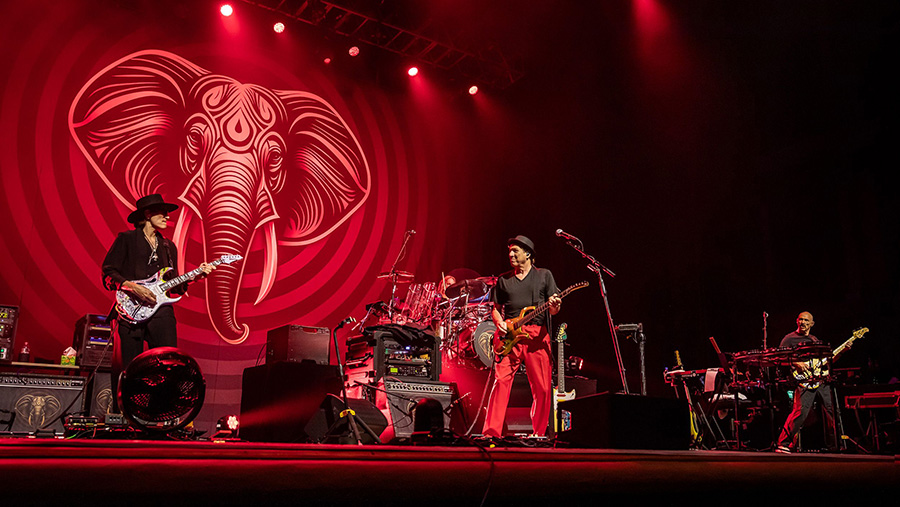
BEAT, the project in which former King Crimson members Adrian Belew and Tony Levin, together with guitarist Steve Vai and Tool drummer Danny Carey, perform the music of King Crimson from the eighties, appeared on 11 June 2026 at the Mitsubishi Electric Hall in Düsseldorf. Four world-class musicians, a repertoire that ranks among the most demanding in progressive rock, and yet an evening that never truly took off. The music was untouchable. The experience was not.
The idea is as simple as it is ambitious. Belew and Levin were part of that King Crimson line-up in the eighties that produced three albums: “Discipline” (1981), “Beat” (1982) and “Three of a Perfect Pair” (1984). These records were hardly ever played live after their release. BEAT brings them back. Belew and Levin perform their own original parts, Carey, the drummer from Tool, takes the role of Bill Bruford and Vai that of Robert Fripp. Vai began his career at the age of eighteen with Frank Zappa, who hired him to transcribe his music and affectionately called him his ‘stunt guitarist’, a path he later documented in a long series of solo albums. Fripp and Bruford gave their blessing, with Fripp even suggesting the name, taken from the 1982 album. So not a tribute band, but a new branch on an ever-growing family tree.
The choice of Vai is the most interesting, and anyone who finds it strange has misunderstood it. Vai does not play Fripp’s parts note-for-note. He would likely have rejected that approach, and that is not why he was hired. The techniques that made Vai who he is, two-handed tapping and fluid legato, barely existed when Fripp recorded those angular interlocking lines in 1981 with a pick. If you want a literal reproduction, you hire a precise technician. If you choose Vai, you consciously opt for reinterpretation. That choice is the band’s artistic statement.
The Mitsubishi Electric Hall carries a prog-history within it. In the early seventies, when it was still called the Philipshalle, Pink Floyd, Genesis and Emerson, Lake & Palmer all performed there, long before some of them became global phenomena. Sacred ground, one might say, for a band bringing perhaps the most intellectually demanding prog repertoire to the stage.
Yet on a rainy Düsseldorf evening, the same evening that the football World Cup opening ceremonies were taking place on the other side of the world, the venue was only three-quarters full. For a bill of this calibre, that is almost telling, especially since earlier stops on this European tour showed the same pattern. The audience was mostly older: grey heads who were active in the alternative scene in the late seventies and early eighties, and often still are. A striking number of Zappa shirts, and if you looked closely, an original “Ship Arriving Too Late to Save a Drowning Witch” tour shirt, a garment whose owner could easily have recouped the ticket price on eBay.
The stage setup was classic, with a large backdrop featuring the now familiar elephant head, a modest light show, and a backline that drew attention even before the start because of the musicians involved.
It began with a mishap. “Neurotica” opens with a blast, after which the click track should kick in. That did not happen, so the flying start was slightly less than flying. For a production of this level, it was rather shocking. Belew laughed it off. Vai stood on stage in a flawless mafia suit with a matching hat, fully focused, and once the click finally started, he fired on all cylinders.
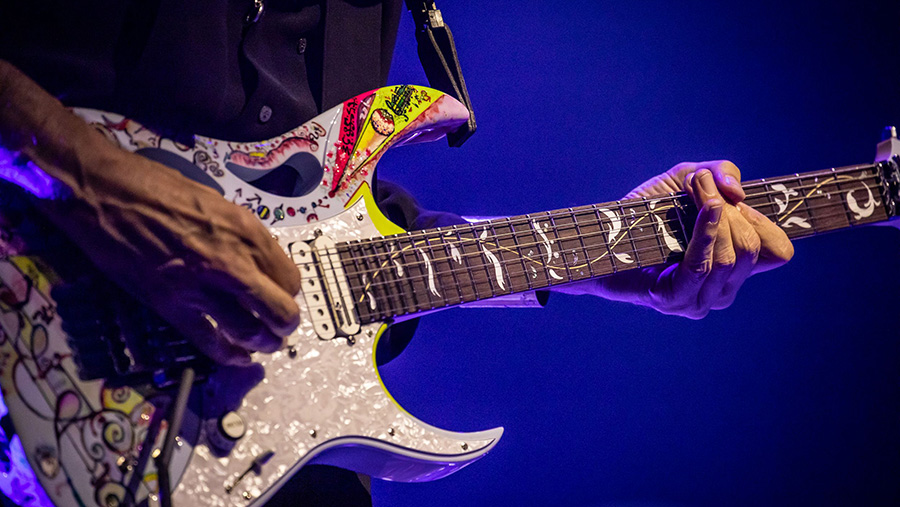
In “Neal and Jack and Me”, the core of the matter becomes immediately clear. Two guitar parts in different time signatures interlock, the principle that made King Crimson on “Discipline” into a kind of gamelan rock: nobody plays the whole pattern; it only emerges through fusion. Belew and Vai delivered this almost flawlessly, and what stood out is how strong Belew is as a guitarist. Vai remained firmly in the role of a serving band member. This was followed by “Heartbeat”, the piece that comes closest on the setlist to a traditional pop song, in a language even a layperson can follow. Pleasant, but not lasting. Curiously, Belew made his joke about ‘playing the easy numbers quickly’ here after “Neal and Jack and Me”, just before the simple “Heartbeat” began.
In “Sartori in Tangier” Levin took up the Chapman Stick, a pleasure in itself to watch. Listening too, although this is where the painful point must be made that the Mitsubishi Electric Hall, in my experience, is a difficult venue for front of house sound at large concerts. Over the years, I have rarely heard major names produce truly satisfying sound there; acoustically, it is a stubborn space. That was again the main issue this evening: too much midrange, harsh highs, and Levin and the phenomenal drummer were underrepresented, meaning the Stick work in particular remained underexposed.
The title “Sartori in Tangier” deserves a note, as it reveals where the music comes from and where it does not. The entire album “Beat” is a homage to the Beat Generation, for whom Tangier was a mythical refuge, the city of William Burroughs and his “Naked Lunch”. The title also references Jack Kerouac’s novel “Satori in Paris”, with Satori meaning sudden enlightenment in Zen, while the altered spelling with an r hints at sartorial elegance, refined dressing. A literary title, not a geographical one. That explains what could be heard in the hall: the scales lean towards the Middle East, not the Maghreb, where they would not be used in this way. It is a Western idea of the Orient in a broader sense, an atmosphere rather than a location. Vai’s guitar synthesiser was, however, turned up very prominently here.
“Model Man” was lighter and allowed a reading of the audience. It remained subdued throughout the evening. No ill will, simply an older audience that no longer gets out of its seat. Nowhere a rock concert atmosphere, always polite applause, at the end a courteous standing ovation, but at no point the feeling of attending an exciting rock show.
“Dig Me” posed the sharpest question of the evening. The piece is unapologetically avant-garde, with diving guitar, unsettling vocals and a structure that constantly threatens to fall apart, ending with the words ‘bury me’. This boldness is to be praised. Yet the question arises how avant-garde the avant-garde still is in 2026. By performing it today, the critics of the time may retroactively be proven right in calling it mostly noise. That is what it was then, and what it is now, only back then it was framed as art. What also stood out: each musician played their own highly concentrated part and kept count, but the whole did not feel collectively played. Had someone been sitting next to them, nobody would have noticed.
After the brief poppy “Man With an Open Heart” came “Industry”, on paper the darkest and most atmospheric moment, with Bowie-like menace and a three-note synth drone. This should have silenced the hall, but it was already quiet from the first note. In Düsseldorf, the piece did not land, likely again due to the front-of-house sound. Vai showed what can be done with a guitar synthesiser, but also remained in the service of the band. This never became the Steve Vai show, and that is a major plus.
The first half closed with “Larks’ Tongues in Aspic (Part III)”, a heavy instrumental piece in which Carey showed why he was the surprise of the evening. Technically, hugely gifted, and whatever is required, the man holds the groove.
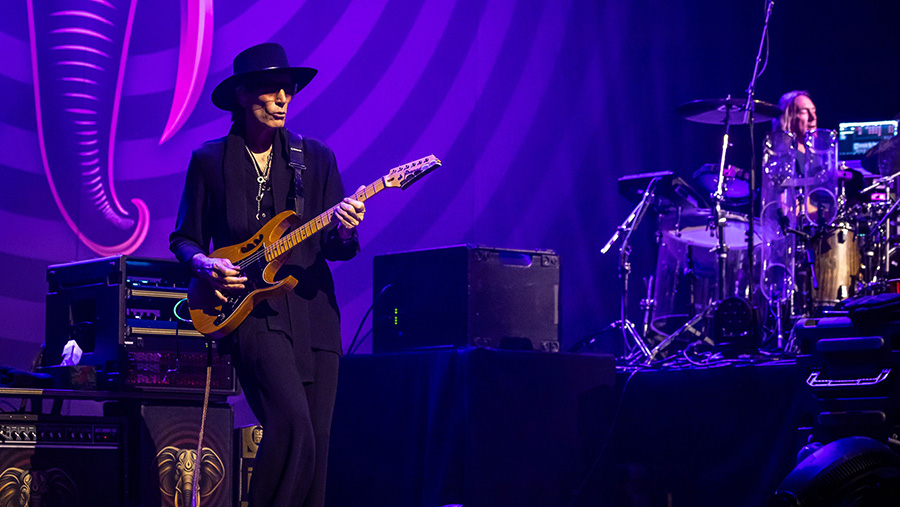
The second half began with “Waiting Man”, the visual and rhythmic signature moment of the show. Carey starts alone on percussion at the front, Belew joins for the phased patterns, then the rest follows. The reference to Steve Reich’s minimalism is obvious, but there is also Philip Glass in it, and here a line can be drawn back through Fripp to his great influence, Stravinsky’s late work. Beautiful, atmospheric percussion, and essentially the only moment where the atmosphere truly reached the hall.
“The Sheltering Sky” was the promised highlight, and here Vai answered the pressing question. He reinterprets the original material in service of the BEAT project and shows what a great musician and composer he truly is. Anyone who saw him in 2023 at the Bridge Festival in Eindhoven with the Metropole Orchestra knows that Vai is at his strongest at the intersection of performer and composer. Here in Düsseldorf, he demonstrated that again. Vai is far more a master musician and composer of real substance than a guitar god. That distinction is precisely why he fits here.
In “Sleepless”, Levin played his famous Funk Fingers, the small hammer devices that give the bass an industrial funk sound. It brought the loudest applause of the evening up to that point. “Frame by Frame”, with its phase patterns, finally gave Vai space to be himself, and it was good that it lasted. Belew’s vocals were weaker here, and Levin’s backing vocals were noticeably untidy and poorly timed, yet again, Belew showed his class on guitar.
“Matte Kudasai”, the ballad with Belew on slide guitar, painfully revealed how much the front-of-house sound in this venue falls short of what one is often used to in the Netherlands. The piece was not transposed down; the question is whether that would have helped the vocals. The feeling would likely have survived a tone lower. After the accessible “Elephant Talk”, the strict “Three of a Perfect Pair” and the theatrical “Indiscipline”, with Belew’s “I repeat myself when under stress” leading into “I like it!”, contact with the hall finally emerged. At the same time, people were already leaving before the encore.
As an encore came “Red”, the title track from the 1974 album of the same name, faster than the original and with inventive drumming from Carey. Belew paid tribute here, as elsewhere on the tour, to Fripp and Bruford. The punky “Thela Hun Ginjeet” then closed the evening, exactly as reports from other cities had suggested. The hall remained calm until the end, no excitement, polite applause, no rock vibe, despite the music.
And so the honest question remains: does this project still work in 2026? The musical level was beyond doubt; an eighty-year-old Levin on bass alone is a marvel to watch. Yet when Steven Wilson played here not so long ago, people were astonished by the music and production. That level was never reached this evening, despite the musicians present. The main culprit, in my experience, was the front-of-house sound in the same venue where Wilson also had to fight that battle and won it. The age of the audience played a role. And perhaps this is simply music that is now regarded with reverence, but no longer delivers the shock it did forty years ago. A wonderful project, craftsmanship of the highest order, and yet an evening that inspired more respect than excitement.


