
Fatoumata Diawara – Massa
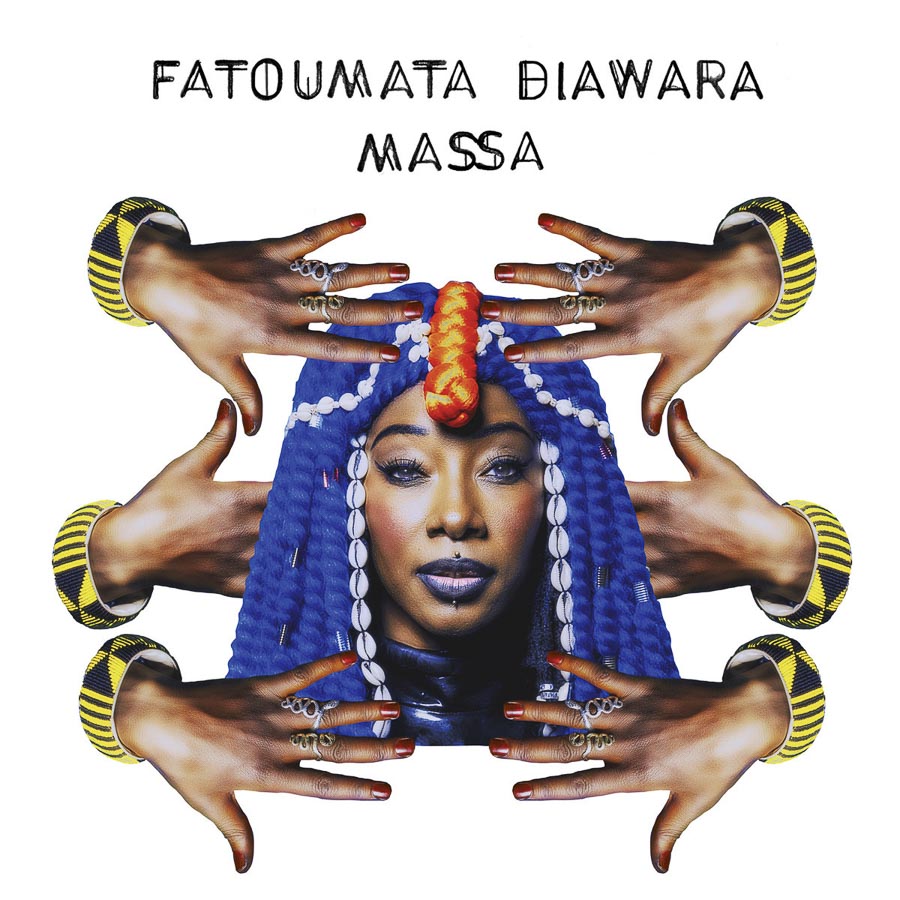
Fatoumata Diawara has created a magnificent pop record with “Massa”, and that is precisely where the discomfort begins. Let us start with the judgement that underpins the rest of this piece: this album should not be assessed as a world music record. Anyone who does so misses what is happening here. The border has disappeared. “Massa” is a pop record, made according to the laws of Western pop production, and the only thing still ‘world’ about it is the voice of the woman who sings it and the language in which she does so. That is not a criticism. It is the first victory of this record, and a greater victory than most reviews will dare to acknowledge.
Fatoumata Diawara is currently the biggest female star Mali has given to the world. Singer, guitarist, actress, Grammy nominee, the first Black woman with her own signature guitar at Gibson Epiphone. She has performed with Gorillaz, Disclosure, Herbie Hancock and Lauryn Hill. Anyone who has followed her work since “Fatou” (2011) has seen an artist grow from restrained Wassoulou folk into something that moved further from the acoustic guitar and closer to global pop with every album. Yet the key to “Massa” does not lie with Diawara alone. It lies with Matthieu Chedid, the French pop giant who calls himself -M-, and with a history stretching back twenty years. At the beginning of this century, Chedid became fascinated with Mali through the blues of Ali Farka Touré and through Amadou & Mariam, who first brought him to Bamako. In 2015, he founded the collective Lamomali, after ‘l’âme au Mali’, the soul of Mali, with kora master Toumani Diabaté, his son Sidiki, and Diawara as the central voice. Two albums, sold out venues, a Franco-Malian family that endured for more than a decade. Diawara and -M- know each other inside out. This is no accidental studio encounter.
And that is why “Massa” possesses a strange duality. On her previous record “London Ko” (2023), Damon Albarn co-produced half the tracks, while -M- was no more than a guest on two songs. Albarn is a genius who has spent his entire career drawing from world music to make his own work more eclectic; he brought his pop rock roots to Diawara, and she retained her own centre of gravity. On “Massa”, Albarn disappears, -M- assumes complete artistic control, and Diawara surrenders herself entirely. The result is the most far-reaching fusion world music has produced in years. The question is whose fusion it is.
Start with “Mogo”. It grooves like mad on an almost Daft Punk style funk riff, in which the spirit of the recently deceased Amadou Bagayoko is unmistakably present, but make no mistake: this is pop music. The production is crystal clear, impeccable as the French would say. Diawara remains recognisable through the choral vocals and Bambara language, but the architecture beneath is Western down to every kick drum. The title track “Massa” confirms the tone: once again that tight, almost Daft Punk style approach to danceable pop, this time featuring the familiar wah wah groove of the Fender Jaguar as we knew it from Amadou Bagayoko. It is telling that Amadou is the spirit haunting this record rather than Toumani Diabaté. The kora master around whom the entire Lamomali project was once built is nowhere to be heard on “Massa”; not a single kora colours these songs. What remains is the electric guitar groove of the man who first brought -M- to Bamako more than twenty years ago. The instrumentation tells the entire story: this is no longer kora driven world music, but Jaguar funk with a Bambara voice. “Tcheba” is another highlight and perhaps the purest proof of the argument. A tight bass and drum foundation that runs throughout the record, a light synthesiser arrangement, finger clicks, an acoustic guitar carrying Diawara’s ethereal vocals. At no point does this song become ‘world music’. This is unequivocally Western style pop music, and it is fantastic.
Most of all, Diawara is “Farana”. Here you hear the Malian blues in the jangling electric guitar, here you feel Amadou again, feel Ali Farka Touré, the heat of the Sahara above the waters of the Niger. And yet this song also fits comfortably within the Western pop idiom. That is what is astonishing about “Massa”: even when the record is most deeply rooted in Malian soil, its form remains pop. We already knew Diawara was an excellent singer. That she can make her voice count within a production that leaves her almost no room for exoticism is the true feat here.
The question that arises is: is this still world music, or a neocolonial capitulation?
Here the critic must take a position, and the temptation to leave the tension unresolved is considerable. Yet the answer is clearer than it appears. The accusation is obvious: a Malian singer smoothed out by a French pop producer into something that fits on a European festival stage and in a Spotify playlist. A capitulation to the market. But that accusation does not hold, and it is important to explain why. Capitulation would mean that Diawara had diluted her Wassoulou roots in order to become more accessible. She does not do that. Instead, she leaves the most uncompromising part of herself untouched, her voice and her language, while allowing everything around them to become Western. The label ‘world music’ exists solely from a Western perspective: it is everything that is not us. Diawara simply refuses that category. She makes a pop record in Bambara, thereby smuggling her language into the pop canon instead of allowing it to be excluded from it. Compare it to Tinariwen, which on “Hoggar” chose exactly the opposite path: back to Tamanrasset, deeper into its own tradition, away from the festival circuit. Two escape routes from the same prison. Tinariwen escapes by retreating into its essence; Diawara by abolishing the category altogether. Both are legitimate. This is not a bowing of the knee but a choice, and everything suggests it is Diawara’s own choice.
And yet “Massa” hurts, in a place where praise cannot erase the pain.
Because the movement is one way. Diawara has come towards us. -M- does not move towards her in return. He pays tribute to Amadou Bagayoko in the guitar groove, scatters his love for Mali across the record, but he does not make Malian pop. He makes M music with a Malian voice on top. This is not the mutual fertilisation we heard when The Cavemen and Pa Salieu allowed London and Lagos to merge into a synergistic whole. Here the traffic only flows in one direction. Mali’s biggest female star turns the corner and makes a pop record in Bambara, while the French producer on the other side of the table takes no step backwards. Perhaps that judgement will change if -M- attempts next year to make genuine Malian pop, to travel the distance himself. But little suggests that will happen. And the most bitter footnote of all: the audience that will embrace this record is in Europe. In Mali, people currently have other concerns than a Spotify subscription or a CD. The fusion that “Massa” strives for is a meeting for which only one party travels.
“Massa” is a beautiful, crystal clear, virtuosic pop record by one of the finest singers in the world, and at the same time a document of an imbalance that music history has known for a century. Diawara has erased the boundary between world music and mainstream pop, and that is an achievement. But she crossed it alone. There lies the beauty, and there lies the loss. This is the most far-reaching fusion in years, and precisely for that reason the loneliest. (8/10) (Nø Førmat!)


