
BEAT beats King Crimson in 013 Tilburg
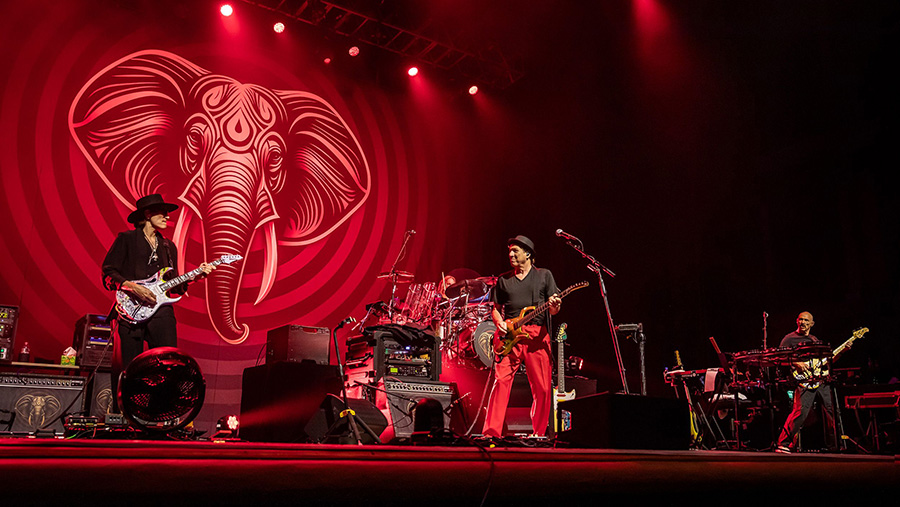
A cover band… nothing more than a cover band… That’s how a non-expert might describe the legendary men of BEAT. And well, in fact, he would be right, if it weren’t for the fact that this might just be the most complete cover band in the world, with the most virtuosic musicians ever. No, you can’t call BEAT a cover band, because when Adrian Belew and Tony Levin asked Bill Bruford and Robert Fripp to bring the 1980s version of King Crimson back to the stage once more to perform those masterful landmark albums, the two legends liked the idea but politely declined. When Belew and Levin then asked thoroughbred artists like Steve Vai and Danny Carey, Fripp and Bruford also gave their blessing to the quartet, which — out of respect for Fripp — was not named King Crimson but BEAT, after the album of the same name. The connoisseurs knew enough…
From the moment the four horsemen took the stage at 013 in Tilburg, the Netherlands, together on Wednesday evening, a palpable tension hung in the room. Could a completely different lineup do justice to the complex and idiosyncratic material King Crimson once put to record? After more than two hours of playing, the answer seemed a resounding yes.
The project goes by the name BEAT and explicitly does not want to present itself as a cover band or supergroup, even though in practice it is a bit of both. Belew and Levin were themselves once members of King Crimson, during the period in which the band, according to many, produced its most daring and adventurous work. Vai, known for his career as a guitar virtuoso, and Carey, the drummer of Tool, rounded out the lineup, each bringing their own signature without betraying the character of the original material.
In Tilburg, dressed in cheerfully exaggerated outfits with a nod to the eighties, the focus was mainly on the angular and driven work the band had produced back then. The first set consisted largely of songs that were rarely played live at the time, including the inscrutable “Industry” and the frantic “Dig Me.” Belew dryly remarked that the band had deliberately started with the more accessible material, a comment that was met with laughter. What followed was music that felt simultaneously chaotic and tightly controlled, full of sharp guitar lines, unusual vocal effects, and rhythms that constantly shifted direction. The interplay between Belew and Vai stood out in particular: however different their approaches, they kept coming together with razor-sharp timing.
The heart of the program lay with the three albums the band released in the 1980s: “Discipline,” “Beat,” and “Three of a Perfect Pair.” Even a song never played live by King Crimson itself made an appearance, “Model Man.” But also several songs only ever played live in the early 1980s, “Dig Me,” “Industry,” “Sartori in Tangier,” “Man with an Open Heart,” and the experimental “Larks’ Tongues in Aspic (Part III),” made their way into the set. The audience got to enjoy gems from days gone by that, in all likelihood, they had never heard performed live before. After the break, the focus shifted to somewhat more accessible material, with songs like “Frame By Frame” and “Matte Kudasai,” though even that was rarely simple fare. The music moved continuously between clashing and merging influences from prog, jazz, and experimental rock — complex and demanding, but for those with ears for it, also remarkably adventurous. BEAT did not aim for a faithful reproduction of the originals, but instead used their own class and experience to arrive at more contemporary-sounding interpretations.
Throughout the evening, it was clear the four musicians visibly enjoyed each other’s playing. Carey, for his part, did not present himself as the pounding powerhouse drummer he can be in Tool, but played in a restrained and sensitive manner, at times alongside Belew behind a set of rototoms. Levin, on his Chapman Stick and his signature basses, not only provided the rhythmic foundation but also kept the sound warm at moments when the music threatened to veer toward a harder, more industrial edge.
Vai’s contribution was of equal importance: where Fripp’s guitar work once sounded almost mathematically precise, Vai gave the songs a more flowing and organic character, without sacrificing any virtuosity. After dozens of collaborations, it seemed as though Vai had finally found his band, such was the evident joy with which the master engaged in the interplay. For him, of course, a simple outing, since with just one guitar around his neck he could excel to perfection.
Toward the end of the performance, the band gave a nod to Crimson’s more distant past by playing an instrumental track from the album “Red,” a detour outside the actual concept of the evening and at the same time a tribute to Fripp and to the late John Wetton. The closing number of the evening sparked exuberant reactions at the front of the room, where part of the audience jumped along as if it were an ordinary singalong song rather than intricate polyrhythms.
Spectacle in the form of video walls, lasers, or other visual trappings was entirely absent that evening. Just a large backdrop featuring the by-now iconic elephant that serves as the band’s logo. With this performance at 013, BEAT confirmed that reinterpretation need not be the same as imitation. Four veteran master musicians, advanced in age but with undiminished joy and precision, gave King Crimson’s material a colour of their own without letting go of the essence of the original compositions. BEAT, a little cover band… but one that surpasses King Crimson… that much is certain…


