
Youssou N’Dour powers through Liège
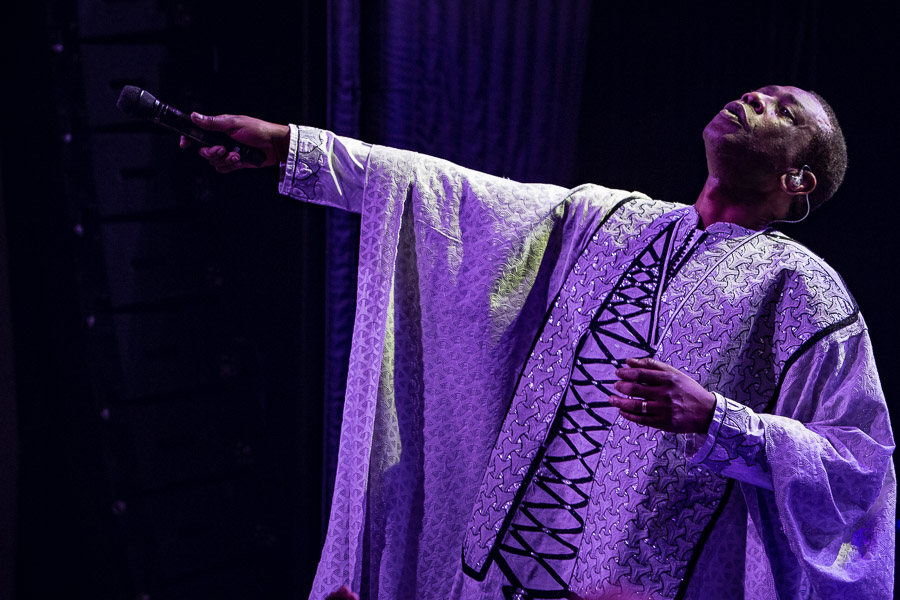
On Saturday, 18 April 2026, Youssou N’Dour brought Le Super Étoile de Dakar to Le Forum in Liège, Belgium, officially one of the European stops on the tour for his latest album, ‘Éclairer le Monde’. That it was going to be something quite different was obvious long before the doors opened.
Le Forum is a venue that carries its own history. The Art Deco hall on the Rue Pont d’Avroy, designed in 1922 by architect Jean Lejaer, is known locally, with a measure of civic pride, as the Olympia of Liège, and is listed as an exceptional heritage of the Walloon Region. Jacques Brel, Édith Piaf, Louis Armstrong, Ray Charles, Miles Davis and Ella Fitzgerald have all performed there; that night, the most revered living voice of the African continent joined the list. That alone could carry a concert. But anyone who got in on time could tell at once that the audience had no intention of letting this evening pass as an ordinary promotional show.
Because this was, in everything but its official billing, a miniature edition of the legendary ‘Grand Bal de Youssou N’Dour’ that has served as an annual pilgrimage in Dakar for decades. That this edition was taking place in Liège of all places was, for anyone without the Senegalese community of the Benelux on their radar, a small revelation. From France, Germany, Luxembourg, Belgium and the Netherlands, the diaspora had travelled to Liège to see in the flesh the most popular Senegalese of all time. Whole families had taken to the road for this one night.
Before a single cymbal had been struck, Le Forum was already a loud hall of reunion. Friends who hadn’t seen each other in years fell into each other’s arms. There was kissing, hugging, laughing, sometimes a name whispered as if the recognition itself were incredible. In between, new conversations formed: someone from Rotterdam meeting their table neighbour from Strasbourg, children speaking Wolof with other children, parents swapping photos on their phones. The evening wasn’t yet on music, but it was already standing. That gathering is in itself one of the biggest things a Youssou N’Dour concert does: it brings families and old friendships back together, and forges new ones at the same time. There was something in the air that could, without pathos, be called magical, and it was not going anywhere.
The support programme looked more like a playback show in a small-town parish hall than a warm-up for a two-thousand-seat theatre. First, three young men walked onto the stage who looked as though they’d come straight in off the street: Panache Culture. On paper, and on their well-kept website, the name stands for a fully fledged Belgian reggae-afrobeat outfit with a complete Bob Marley tribute in their repertoire. What actually appeared on the Le Forum stage were three somewhat tired friends singing a handful of numbers over backing tape in which Marley was imitated so faithfully that at times it tipped into karaoke. The audience was perfectly fine with it and clapped along obediently. Then came Paco Diatta, dressed as a Dakar pimp in a white jacket with a Senegalese flag draped over it, also on tape, mainly occupied with working the room. He, too, passed off his own accord. Again: everyone is happy. The whole thing said more about the patience and goodwill of the audience than about the rigour of the programming.
The lights went down, and in the seconds that followed, the tension rose inside Le Forum the way it had, three months earlier, in Rabat, before the Africa Cup of Nations final that Senegal won. Le Super Étoile de Dakar came up as one solid block: tamas, sabars, guitars, keyboards, horns, backing vocals, all at their stations. And then he appeared. That unhurried walk that cannot be imitated, a short gesture to the room, and that voice, still at an altitude nobody has joined him at in forty years.
After which, Youssou N’Dour did something only Youssou can do. He opened the concert with ‘7 Seconds’. His biggest international hit, the one that dominated Western European radio for months in 1994 and placed his name in the ears of hundreds of millions. Where most artists save that kind of fireworks for the encore, Youssou slides it straight to the front. It is an almost nonchalant manoeuvre with a clear aim: anyone who came for that one song has already got what they came for; anyone who came for Youssou knows that the actual work only begins now. Out of the way, and on. The part Neneh Cherry sang on the studio version, and which Dido later took over on stage at Live 8 in Paris in 2005, was carried in Liège with verve by Le Super Étoile’s female vocalist. She placed the melody exactly where it needed to sit. The point was made. Everyone was in.
Within a minute, the audience was standing on the seats. Le Forum had been played flat before the match had properly started.
After that opening, the mbalax machine shifted gears, one at a time. ‘Immigrés/Bitim Rew’, the title track of the 1984 album that first put Peter Gabriel on Youssou’s trail, was what genuinely cracked the room open. It is the anthem of the diaspora, written as a letter home by a Senegalese immigrant in Paris, and the strange part is that people who hadn’t yet been born in 1984 sang it along here word for word. Within a minute, the stands had turned into one swirling, sabar-dancing mass. This is what these people had come for. Senegalese pride, not as an abstraction, but as bodies moving together in the same direction, in a hall in Liège.
On stage, the old guard was smiling. Mbaye Dièye Faye, behind the percussion section since Le Super Étoile’s very first cassettes, and grand master Assane Thiam in front of him on the tama. They have done this a thousand times and, under the direction of the King of Mbalax, can steer a room to the millisecond. Youssou regularly handed the lead to Mbaye Dièye Faye: while Youssou caught his breath, Mbaye Dièye Faye pulled dancers up from the audience, laid the sabar section on top and handed the room back to his king. The crowd and band had become one organism. No one in Le Forum, at that hour, was unhappy.
From there it went everywhere. ‘Li Ma Weesu’, in which Youssou looks back at his own past as if into a mirror. ‘Liggeey’. And ‘Birima’, with that spellbinding intro that Jimi Mbaye himself wrote for the song, and which has been one of the most recognisable opening sounds in Senegalese music since 2000. Jimi Mbaye, Youssou’s guitarist for forty years, died in February 2025. Habib Faye, the bassist who helped shape Le Super Étoile’s harmonies, had gone before him in 2018. The reign of mbalax continues, even without its fallen heroes. The new album includes ‘Jimi Mbaye Dogo (Hommage du Super Étoile de Dakar)’ for a reason, and anyone listening closely that night heard in almost every solo something that brought him or Habib to mind.
Then came ‘Senegal Rekk’, and the sing-along song of the evening was answered, line for line, by 2000 voices. This was also where the motif Mbaye Dièye Faye and Youssou kept bringing back as a refrain all night landed in full: ‘les champions d’Afrique’. The diaspora roared it. What an appeals board of the African football confederation had corrected on paper in March was, here, among 2000 people shouting in Wolof, simply wiped off the table. The final in Rabat had been won on the pitch, and the room stood by that. It was the running gag of the night, played between band and audience as an in-joke everyone was invited into. On ‘Telepathie’, it went one layer deeper. These are not songs that an audience knows. These are songs by which an audience recognises itself: anyone standing there was not opposite an artist, but inside a collective story unfolding in every beat at once. The energy was almost literally palpable, electric against the Art Deco walls. People were hanging off the lamps and dancing across the hundred-year-old balcony that had once held Jacques Brel and Ella Fitzgerald and that now took to sabar as if it had always done so.
A Grand Bal is no Grand Bal without surprises. Halfway through, Youssou called Moustapha Diakhaté up onto the stage: the 24-year-old Senegalese-Belgian MMA fighter who, eight days earlier on 10 April 2026, at the Adidas Arena in Paris, had taken the ARES world title in the light heavyweight division by taking apart compatriot Paulin Begai over five rounds on unanimous decision. The “Baay Fall” came up with his championship belt around his waist to salute the crowd. That kind of unannounced crossover between top-flight sport and top-flight music is something you only see at a Youssou N’Dour concert. Toward the end of the evening came another surprise: Soda Bousso Seck, a name that barely registers in Europe but is not a small one in Dakar. Twenty years of a career as a singer, dancer and percussionist, and, by her own account, the first Senegalese woman to play tam-tam on the Champs-Élysées. In the sabar circuit, the drums are traditionally a male domain, the dance a female one, and Soda Bousso simply pushed that line aside. She sang and shared the stage in Liège with Youssou, as she had before 2021 with Thione Seck. While the two voices slid into each other’s lines, Senegalese members of the audience threw euro notes in her direction, exactly the way it has been done for decades at the Théâtre Sorano in Dakar.
For the final note, Youssou had one more thing to give, and everyone in Le Forum knew what. ‘I Love You’, from the 2016 album ‘Africa Rekk’, which he traditionally keeps for the moment when the whole hall needs to settle and breathe together. No grand bal any more, no percussion storm, just that voice and those three words, directed straight at his people. His family. His fans. His base. This is the reason he has, for more than forty years, occupied a place in Senegal closer to a godlike figure than to an ordinary pop star: not because he stands above his audience, but because at every concert, as again tonight in Liège, he makes clear to himself that without that audience he is nothing. He sings those three words toward them as if it were the first time he had ever said them. And the room sings them, as always, back.
Anyone who walked out of Le Forum shortly before midnight was not walking away from a concert. They were walking out of a space that had, for a few hours, been Le Thiossane: the nightclub in the Sicap district of Dakar that Youssou bought in his twenties and still owns today. There, on every Friday and Saturday night when he is not on tour, this is what is played. Le Super Étoile is going well past two in the morning, sabar dancers cutting through the music, people from the audience pulled up onto the stage, CFA francs flying through the air. Le Thiossane is, for anyone who wants to play alongside the King of Mbalax, the strictest school there is. Assane Thiam has been there since 1979, Mbaye Dièye Faye since the early 1980s. The younger musicians who now stand with them have earned, night after night, the right to play at this level next to Youssou himself. Fall short there on a Saturday, and you are not on that stage the following week. And anyone who makes the journey from that club in Sicap to an art deco hall on the Rue Pont d’Avroy carries that work visibly with them. That is what Le Forum saw on 18 April: the endpoint of daily labour, delivered with the ease of people who have done it ten thousand times.
On 1 October of this year, Youssou N’Dour turns 67. On this night in Liège, with your eyes closed, he still sounded exactly like the boy who first stepped onto a stage with Le Super Étoile in 1979. May he reach a hundred. Then, and only then, will we write him up in full.


