
Precious Pop Pearls: The Story Behind Cameo – “Word Up”
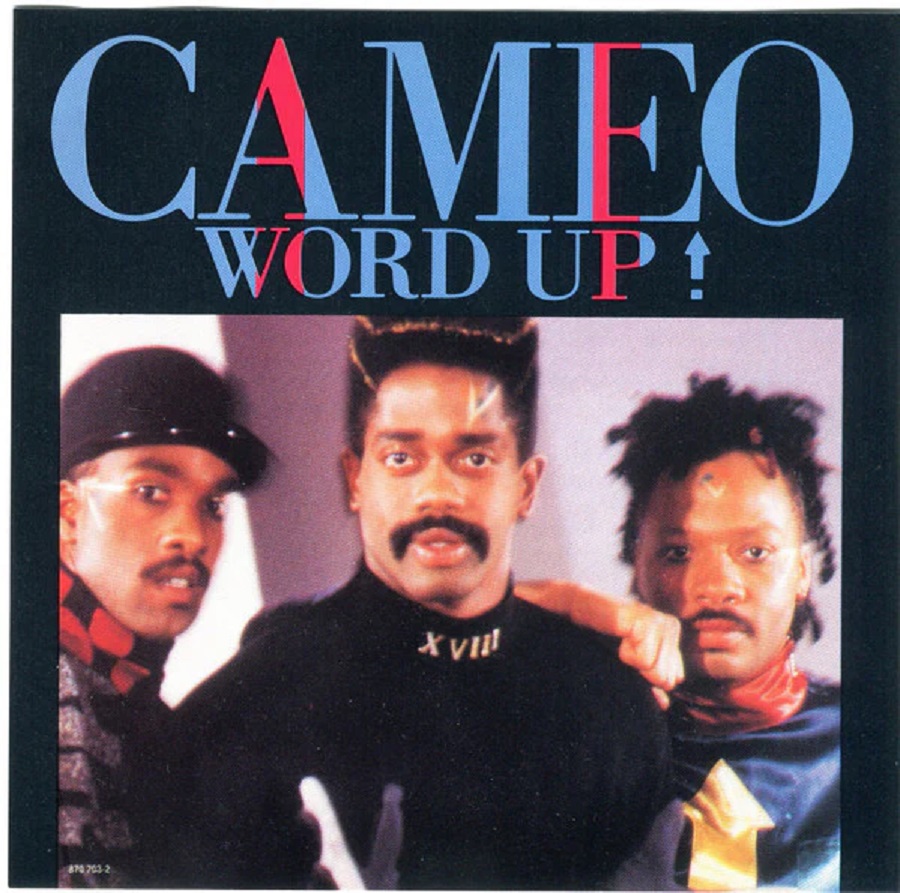
Some songs define an era without being entirely consumed by it. “Word Up” by Cameo is one such track. Released in 1986, it sounded like nothing else playing on the radio at the time, yet it immediately took hold. The piercing synthesiser melody, the springy bassline, the dry drum kit and the commanding, almost authoritarian voice of Larry Blackmon combined into a cocktail that kept hammering through the mind while dancing. More than forty years later, the power of that track remains undiminished. How did it come about, and what made it so special?
Cameo
The road to “Word Up” did not begin in a studio, but on the streets of Harlem. Larry Blackmon, the man who would later become infamous for his striking red codpiece and distinctive hi-top hairstyle, grew up in the shadow of the Apollo Theater. As a child, he was taken there by family members and later went on his own, where he saw everyone from Otis Redding to Marvin Gaye. That early exposure to the Black musical tradition would shape the rest of his life.
In 1974, Blackmon founded the New York City Players, an ensemble that soon had to change its name due to conflicts within the music industry. The name Cameo was eventually taken from a cigarette brand the band encountered during a visit to Canada. In the early years, Cameo was an impressively large ensemble, with horn sections and a tight rhythm section rooted firmly in the funk tradition. Blackmon also took classes at the Juilliard School of Music while working as a tailor during the day. The fusion of those two worlds would always be felt in his music: the precision of a craftsman combined with the fiery energy of the street.
The 1980s brought a series of albums that gradually pushed the band further into the mainstream, particularly through the shift towards electronic production techniques. In 1983, with the album “Style”, Cameo began placing electronic instrumentation at the centre instead of the typical large funk sound. That experiment led to a temporary dip but also laid the groundwork for what was to come. With “She’s Strange” in 1984 and “Single Life” in 1985, the band steadily built a new audience, both in the United States and the United Kingdom. Still, audiences outside the R&B world had not fully embraced them. That would change dramatically in 1986.
Word Up
The story behind “Word Up” begins with an idea, a mood and an attitude. Cameo leader Larry Blackmon drew inspiration for the growling, restrained vocal style from his hero Sly Stone. The lyrics were based on a character that Blackmon and co-writer Tomi Jenkins called ‘Vicious’: someone irritated by DJs more concerned with their own image than with keeping the dancefloor alive. It was, therefore, a protest story disguised as a dance track.
The song breaks away from the disco-influenced sound of Cameo’s earlier work and can be described as funk, funk rock and synth funk. The production is sparse: a tight drum sound, a rubbery, elastic bassline and that high, siren-like synthesiser tone that makes the intro instantly recognisable. Like the previous single “Single Life”, “Word Up” contains a reference to the opening notes of the theme composed by Ennio Morricone for the film The Good, the Bad and the Ugly. That western influence matches the commanding, almost threatening cool of the track.
The music video played a major role in its success. Blackmon’s iconic red codpiece, his bold presence and the sharp choreography turned the video into a visual spectacle that received heavy rotation on MTV. The song became Cameo’s first US top 40 hit, peaking at number six on the Billboard Hot 100, spending three weeks at number one on the Billboard R&B chart and one week at number one on the Billboard Hot Dance Singles chart. In the United Kingdom, it spent ten weeks in the top 40, peaking at number three. In New Zealand, it even reached the very top. The song won the Soul Train Music Award for Best R&B/Soul Single and the NME Award for Best Dance Track.
In 1986, artists such as Janet Jackson, Prince, Lionel Richie and Whitney Houston dominated the charts. Funk and R&B were poised to enrich the dance pop of the era, but few songs were as radically stripped down and yet as forceful as “Word Up”. While contemporaries such as Janet Jackson worked with lush, layered productions under Jimmy Jam and Terry Lewis, Blackmon chose the opposite: space and power through minimalism.
Korn
The lifespan of a great song is also determined by the covers it inspires. Few reinterpretations of “Word Up” have been as unexpected as that by the American nu metal band Korn in 2004.
The story begins at a soundcheck. Singer Jonathan Davis has said that the band had been playing “Word Up” for years as a warm-up before shows, never the full version, but fragments and riffs to get into the groove. The track had therefore held them in its grip long before recording. When Korn worked on their first retrospective album, “Greatest Hits, Volume 1” in 2004, they decided to finally record the cover in full and make it the opening track. The musical approach is close to the version Gun made a decade earlier, but Korn played it on a seven-string guitar in a lower tuning, making the sound heavier and more menacing.
The single was released in July 2004 and reached the top twenty on two Billboard charts. In the United Kingdom, the cover reached number six. It was also the only Korn single ever deliberately sent to Top 40 radio stations, receiving airplay on influential stations such as New York’s Z 100. The music video, directed by Antti Jokinen, showed the band members as digitally altered dogs in a club scene, a nod to Basement Jaxx’s video for “Where’s Your Head At”. The album “Greatest Hits, Volume 1” debuted at number four on the Billboard 200 and achieved platinum certification. The cover of “Word Up” once again proved the strength of the original: the song fits any style an experienced band wraps around it, whether funk, hard rock or heavy metal.
Word Up!, the album
The single was also the face of an album that took Cameo to unprecedented commercial heights. The album “Word Up!” reached number one on the Top R&B chart and number eight on the Billboard Pop Albums chart, and was certified platinum for selling over one million copies in the United States.
The production of the album largely took place in New York and was entirely handled by Blackmon himself. His approach was that of an architect: every element had a function; excess was eliminated. In addition to the title track, the album contained two other major hits. “Back and Forth” reached number eleven in the UK charts. Then there was “Candy”, the album’s second single, which reached number one on the US R&B chart in early 1987. The snare drum sound Blackmon designed on this album was imitated by a wide range of artists and helped shape the sound of the late 1980s.
She’s Strange
To fully understand the leap to “Word Up”, one must also know the buildup. One of Cameo’s most important songs from the preceding period is “She’s Strange” from 1984. The album of the same name reached number one on the US R&B album chart, and the title track topped the R&B singles chart. The song sounds like a blueprint for what would follow: electronic elements are present, the funk is rawer than on earlier records, and Blackmon’s vocal delivery carries the simmering intensity that would explode two years later in “Word Up”.
“She’s Strange” was the announcement that Cameo was building something new, although audiences did not yet know what it would lead to. Its success allowed the band to choose its own direction and reach a new audience without losing the loyalty of its R&B core. It also proved that Larry Blackmon, as a producer, was developing a musical language that functioned entirely on his own terms.
A legacy in sound and movement
The story of Cameo and “Word Up” is also the story of a band that reinvented itself multiple times without losing its essence. After the peak of 1986, the band continued recording and performing, although none of their later work reached the commercial scale of the “Word Up!” album. Blackmon remained active as a producer and also worked as an artistic director at a major American record label in the early 1990s.
Cameo’s influence spread into later generations of music through sampling. “Candy” was sampled by numerous hip hop and R&B artists, from 2Pac to Mariah Carey and Beyoncé. “Word Up” itself continued to attract covers from a wide range of artists. In addition to Gun, the nu metal band Korn released their own version in 2004 that received significant airplay on alternative radio stations.
That a song can enter so many different musical worlds and feel at home everywhere says everything about the quality of the composition. “Word Up” is not a product of its time; it is a blueprint whose validity does not expire. It began as the outburst of a man who grew up near the Apollo Theater and wanted to say something about the soul of music. That it ultimately travelled the world was no coincidence. It was the result of talent, timing and an inescapable groove.


