
Precious Pop Pearls: The Story Behind Carl Douglas – “Kung Fu Fighting”
Some songs become unexpected documents of their time. “Kung Fu Fighting” by Carl Douglas is a striking example. With its recognisable ‘hoeh’ and ‘hah’ sounds, tight bassline, and infectious rhythm, the single sold eleven million copies worldwide in 1974. Most listeners do not know that this disco classic came together in barely ten minutes, was originally conceived as a B-side, and almost got lost. The creation of this hit is a story full of chance, cultural convergence, and the right moment when a melody captured an international movement.
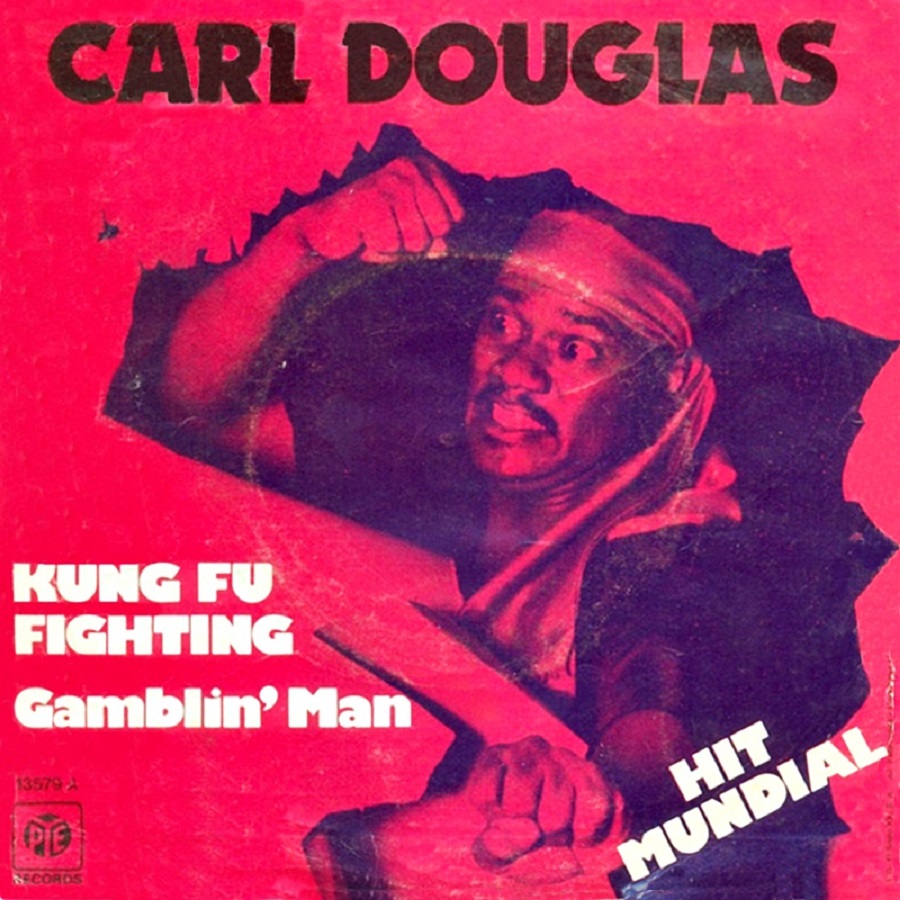
The history of “Kung Fu Fighting” is one of improbabilities. A Jamaican-British singer and an Indian producer meet in London. A B-side recorded in ten minutes. A song about Chinese martial arts that appears at precisely the right moment to ride a global cultural craze. Radio DJs and club DJs are giving the track a chance despite lacking initial airplay. An audience responding massively, dancing, moving along, making the track a worldwide phenomenon.
Carl Douglas
Carlton George Douglas was born on 10 May 1942 in Kingston, Jamaica. As a child, he moved with his family first to California before settling in London as a teenager. In England, Douglas grew up with two passions: football and music. He developed a trained tenor voice, singing in church choirs where he performed religious music. His greatest musical inspirations were soul legends Sam Cooke and Otis Redding, artists whose emotional depth and vocal power shaped him as a singer.
In the 1960s and early 1970s, Douglas mainly worked as a session musician in the London music scene. It was an anonymous existence, filled with backing vocals and studio days that barely paid. He sang on demos, lent his voice to other projects, and waited for his big break. That break did not come for many years. Douglas belonged to that group of talented but unknown singers populating the British music industry, always seeking the one chance that would transform their career. Few could have predicted that this chance would come in the form of a hastily recorded B-side about martial arts.
Kung Fu Fighting
The story of “Kung Fu Fighting” does not begin with Carl Douglas alone, but also with the producer who made the record possible: Biddu Appaiah, better known simply as Biddu. Born in 1945 in Bangalore, India, Biddu was a music producer who sought to bridge the East and West. In the 1960s, he formed a band called Trojans, the first English-language ensemble in India, performing covers of The Beatles, The Rolling Stones, and other Western pop stars. This experience gave him a taste for international pop music.
In 1967, Biddu moved to England with little money and big dreams. His journey through the Middle East was largely by hitchhiking, performing songs in exchange for food and lodging. In London, he first worked as a cook at the American embassy to make ends meet. Gradually, he worked his way up in the music industry. In 1969, he scored his first success with a hit for the Japanese band The Tigers. In 1972, he composed the music for the British thriller “Embassy”. But his breakthrough was yet to come.
In August 1974, Carl Douglas was in the studio recording a single. The A-side was “I Want to Give You My Everything”, written by American songwriter Larry Weiss, who had just composed “Rhinestone Cowboy”, a song Glen Campbell would take to number one a year later. High expectations surrounded Douglas’ version of “I Want to Give You My Everything”. Biddu had hired Douglas to sing this serious ballad, and they booked a three-hour studio session.
After over two hours of recording and a break, only ten minutes of studio time remained. Biddu realised they still needed a B-side for the single. He asked Douglas if he had any lyrics they could quickly use. Douglas showed him several options, including a song he had written after a night in Soho. He had seen children on the street mimicking kung fu moves, inspired by the martial arts films that were extremely popular at the time. He turned to his friend and said, ‘Damn, it looks like everyone is doing kung fu fighting.’ At that moment, he heard the whole melody in his head.
Biddu chose this song and quickly worked out a melody. Since it was just a B-side, he decided to go over the top with the ‘huhs’ and ‘hahs’ and chopping sounds. They recorded only two takes in those last ten minutes. According to Biddu: ‘Kung Fu Fighting was the B-side, so I exaggerated with the sounds. It was a B-side, who would listen?’ Carl Douglas, improvising his own vocal additions, thought the same. No one in that studio could have foreseen what would happen.
What followed was nothing short of a miracle. Robin Blanchflower of Pye Records heard both songs and insisted that “Kung Fu Fighting” be the A-side instead of “I Want to Give You My Everything”. After release, the track received no radio airplay for the first five weeks and sold poorly. But in dance clubs, it slowly became popular. DJs played the record and saw dancers rush to the floor as soon as the recognisable intro started.
On 17 August 1974, “Kung Fu Fighting” entered the UK Singles Chart at number 42. A month later, on 21 September, it reached number one, where it remained for three weeks. The single was subsequently released in America via 20th Century Records, where it topped the Billboard Hot 100 for two weeks in December 1974. The track also reached the top of the Soul Singles chart, a testament to its broad appeal across racial and cultural boundaries.
The worldwide conquest was complete. “Kung Fu Fighting” reached number one in countries like Australia, Canada, France, Germany, the Netherlands, and Belgium. Eleven million copies were sold worldwide, making it one of the best-selling singles of all time. In 1974, it received a gold certification from the RIAA in America and the BPI in the United Kingdom. At the Amusement & Music Operators Association Jukebox Awards in 1975, it won ‘Jukebox Soul Record of the Year’ for being the most played soul record on jukeboxes that year.
Bus Stop Remix
Nearly a quarter of a century later, “Kung Fu Fighting” got a second life. In 1998, the British dance act Bus Stop released a remix of the track, sampling Carl Douglas’ original vocals and adding rap verses. This version fit perfectly in the late-1990s era when dance and electronic music dominated the charts. The remix combined 1970s nostalgia with modern production techniques and an energetic, up-tempo beat.
Bus Stop’s version reached number eight in the UK Singles Chart and number one in New Zealand. In Australia, the single received a gold certification from the ARIA. For Carl Douglas, it was a surprising return to the spotlight. He contributed to the remix, lent his voice again to the song that had defined his career, and witnessed a new generation embracing the track. The members of Bus Stop, including Mark Hall, Graham Turner, and Daz Sampson (who would later represent the UK at Eurovision 2006), proved that “Kung Fu Fighting” was a timeless song that could adapt to new musical contexts.
Kung Fu Fighting and Other Great Love Songs
The success of “Kung Fu Fighting” led to the release of Douglas’ debut album “Kung Fu Fighting and Other Great Love Songs” on 16 November 1974. The album title is one of the most unexpected and memorable in pop music history, an ironic combination emphasising the contrast between martial arts and romance. The album reached number 37 on the Billboard 200 and number 40 on the Australian Albums Chart. Even more impressively, it reached number one on the Top R&B/Hip-Hop Albums chart, showing Douglas’ music was widely embraced within the soul and disco community.
The album included tracks like “Witchfinder General”, “When You Got Love”, “Changing Times”, and the instrumental “Blue Eyed Soul”. The first follow-up single was “Dance the Kung Fu”, a logical attempt to continue the success of the first hit. The song performed reasonably, reaching the top ten in Belgium, Germany, and the Netherlands, but in America, it peaked at number 48 on the Billboard Hot 100 and number 35 in the UK. It lacked the magic of “Kung Fu Fighting”, that perfect alchemy of timing, melody, and cultural resonance. “Blue Eyed Soul” was released as the third single, reaching only number 25 in the Belgian charts.
During this period, Douglas was briefly managed by Eric Woolfson, who later became one of the primary songwriters for The Alan Parsons Project. In 1976, Douglas released his second album, “Love Peace and Happiness”, with singles “Shanghai’d” and “Run Back”. “Run Back” reached number 25 in the UK singles chart, Douglas’s last UK chart appearance until the Bus Stop remix more than twenty years later. In 1978, he released his third album, “Keep Pleasing Me”, after which he largely withdrew from the music scene.
For Carl Douglas, “Kung Fu Fighting” remained both a blessing and a curse. In America, he is regarded as a one-hit wonder, an artist who shone for one magical moment but never performed at the same level again. But what a moment it was. The song completely overshadowed the rest of his career, defined his identity as an artist, and made him immortal in the annals of pop music.
In several countries, “Kung Fu Fighting” has been recognised as one of the greatest one-hit wonders. VH1 placed it at number 100 in their ‘100 Greatest One-Hit Wonders’ list, while Channel 4 in the United Kingdom placed it at number one in 2000 in their ‘Top 10 One-Hit Wonders’ list. In 2006, Channel 4 repeated this accolade in a more extensive ’50 Greatest One Hit Wonders’ poll. The song was featured in the program “Bring Back the One-Hit Wonders”, in which Carl Douglas performed the track live for an enthusiastic audience.


