
Souad Massi – Zagate
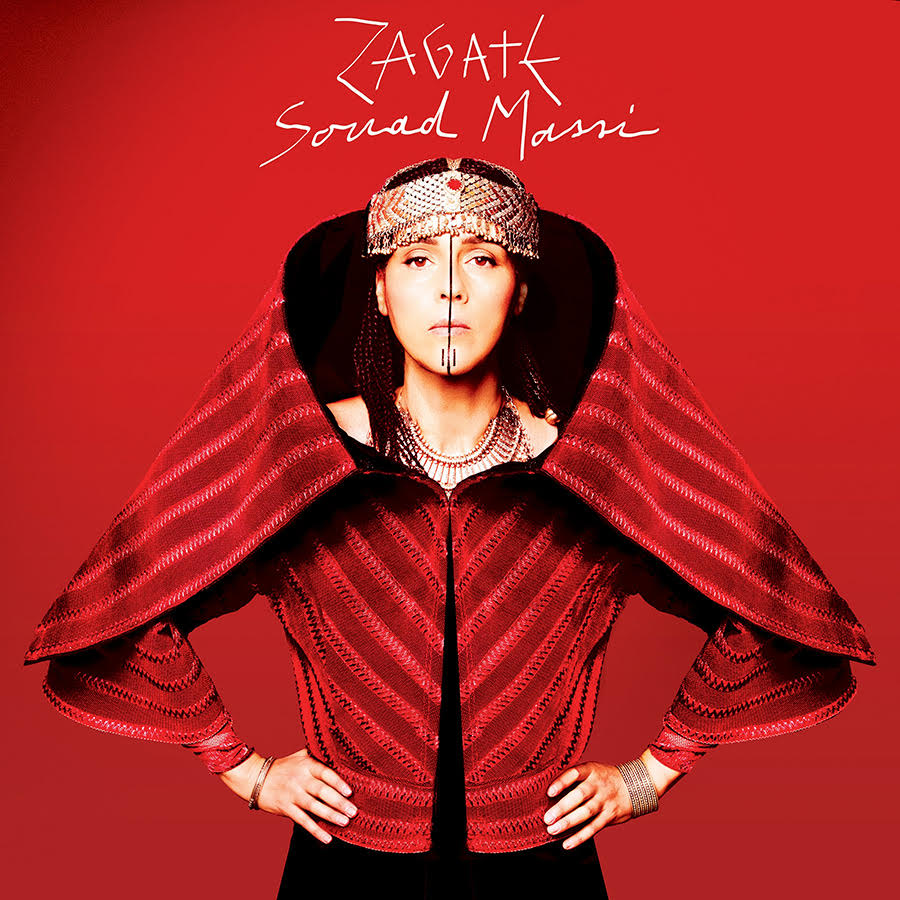
There are moments in a musical career when an artist definitively frees themselves from expectations, from boxes, from the safe paths that have brought success. With “Zagate”, her ninth studio album, Souad Massi has reached such a moment. And what a liberation it has become.
The title says enough on its own. “Zagate”, a distortion of the French ‘ça se gâte’, used in Algeria to indicate that ‘things are going wrong’, is more than a linguistic wink. It is a statement from a woman who has lived for 26 years between two worlds: between Algeria, where she was born, and France, where she creates. It is also a perfect metaphor for an album that breaks all conventions and shows that Souad Massi is much more than the singer the world has come to love.
Let’s be honest: Souad Massi has for years functioned as that soft, melancholic voice of the Maghreb, the troubadour of exile with her acoustic guitar and poetic lyrics. Albums such as “Deb” and “Mesk Elil”, the latter earning her even a Victoire de la Musique, defined her as the messagère douce-amère de l’exil. But those who listened carefully knew there was more. In interviews, Souad has long expressed the wish to return to rock, to the idiom she comes from. To the days of Atakor, her rock band that toured Algeria during the ‘years of lead’.
With “Zagate” she finally dares to take that step. This is not entirely a return to Atakor, as the poetic Souad remains too present. But it is an artist putting her neck on the line, taking risks, refusing to play it safe. And you hear it immediately.
The album opens with “Zagate”, a solid reggae track that instantly makes it clear Souad has evolved. The sultry chorus forces you to dance with your eyes closed, while a surprising Ney solo, the traditional Arab flute, is seamlessly woven into the groove. It is a perfect first single, a track that makes you curious about what comes next.
What follows is the absolute highlight not only of this album, but perhaps of Souad’s entire oeuvre: “D’ici, De là-bas”, her collaboration with poet, rapper, and wordsmith Gaël Faye. This song grows with every listen. ‘Your blood is red, just like mine’, a simple truth that must be shouted from the rooftops in these times. Souad’s voice reaches unprecedented heights here, emotionally and technically, while Gaël Faye’s delivery is superstar level. This duet will belong to the highlights of both their careers, on par with Souad’s previous collaborations with Ismaël Lo and Marc Lavoine, but with an urgency sharper than ever.
On the title track “Zagate”, Souad bares her teeth. Here is the promised return to rock, but not as expected. It is an innovative mix of everything Souad has shown so far, including the rocker from her Algerian days. Marvellous sounds create a delightful groove while an electric guitar duels with an Oud. It is brave, it is urgent, it is Souad Massi allowing herself to be fully herself.
The two “L’Équation” tracks form the other extreme of this kaleidoscopic spectrum. “L’Équation #1” is a beautiful instrumental interlude that would not be out of place on a Dhafer Youssef album. “L’Équation #2”, on the other hand, is chillingly beautiful, a hypnotic recital on universal fear. ‘You are born free, you are born to live’, she sings, and you feel the weight of her experiences, of a woman who has endured it all but has remained human in the purest sense.
“Tiri” presents the familiar Souad, ethereal beauty, deceptively simple with a plucked guitar and drifting bass, with again that melancholic Ney solo hypnotising like a cobra on the Djemaa el-Fna. But after softness comes power: “Ana Inssan” (‘I am a human’) is a straightforward rock escapade where Souad lets her hair down completely and shouts a message that seems obvious but must be repeated again and again.
And then there is “Chibani”, possibly the best track on the album. A delightful rocking guitar intro, a grooving riff, and then the rhythm section enters surprisingly lethargic. This track has the Tinariwen feel of hot Sahara dunes, a track that could just as well have been a collaboration with Mdou Moctar. The phenomenal Fender Rhodes solo deserves applause and a deep bow.
Under the production of English guitarist Justin Adams, who also worked on “Sequana” from 2022, the eleven tracks were largely recorded in England and explore a palette of emotions of rare intensity: pain, anger, revolt, but also courage and hope. From the electric rock of “Ana Inssan” to the enchanting afrobeat of “Samt”, from the Sahara folk of “D’ici, De là-bas” to the Parisian groove of “Chibani”, each track reveals new nuances of her voice.
What makes “Zagate” so special is that Souad Massi has finally created the album she has long wanted to make, but perhaps did not entirely dare. Produced under her own label, Backingtrack Production and distributed via Sony Music Entertainment, she presents herself here more as an artist than ever. She offers us an insight into her own development, her own humanity, in a world that, in her own words, ‘zagate’, is going wrong.
Born in Bab-El-Oued, raised among strong women in a male-dominated world, she studied civil engineering before choosing music. Influenced by Oum Kalthoum, Amália Rodrigues, Joan Baez, Bob Dylan, and Led Zeppelin, she always knew that different worlds can merge. ‘When I first heard Kashmir, I got goosebumps. This Western music I admired finally invited me in,’ she once said.
With “Zagate”, Souad Massi invites us into her world, her anger, her hope, her liberation. Following your heart and taking risks is brave, and Souad Massi shows herself braver than ever with this album. The world that loved her for her softness will now only love her more for her complete self. (9/10) (Backingtrack Production/Sony Music Entertainment)


