
Precious Pop Pearls: The Story Behind Midnight Oil – “Beds Are Burning”
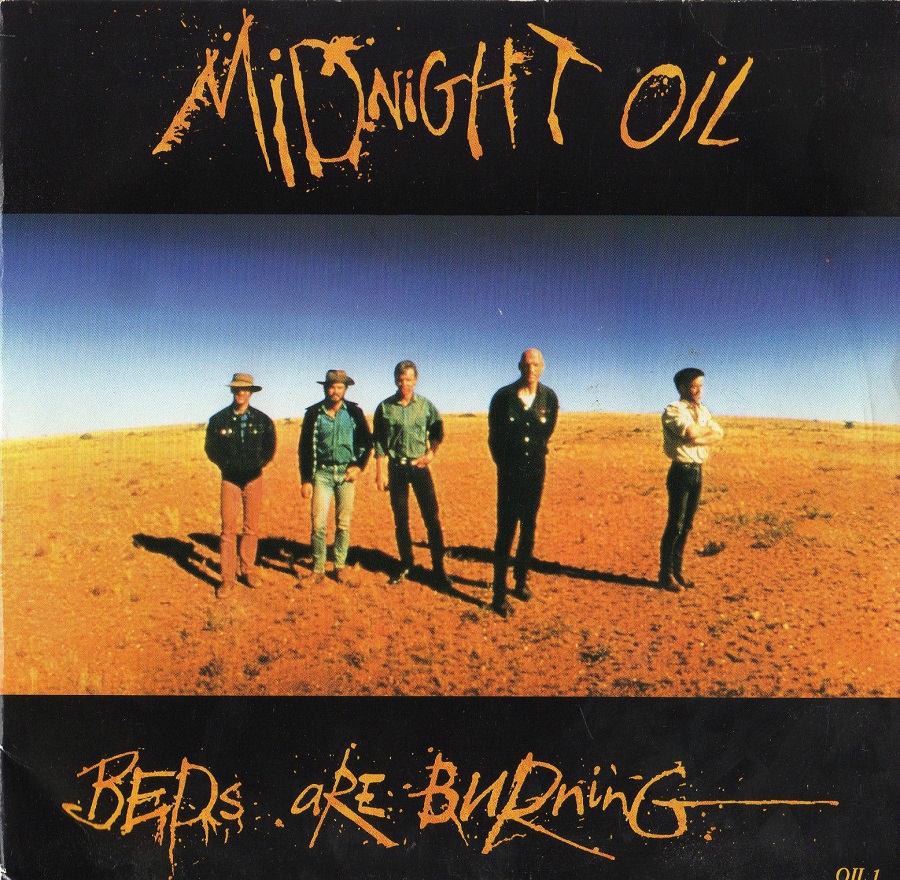
Some songs touch the world because they are universal, songs about love or loss, about recognisable human emotions. And then some songs touch the world precisely because they are so specific, so irrevocably rooted in one place, one people, one injustice. “Beds Are Burning” by Midnight Oil belongs to that second category. A song about the stolen land of the Australian Aboriginals, written by four white men from the city, became a worldwide rock hit in 1987. It is one of the most unlikely stories in the history of pop music, and at the same time, one of the most telling.
Midnight Oil
The story of Midnight Oil begins on the northern beaches of Sydney, where three schoolboys in the early seventies started playing in a band called Farm. Drummer Rob Hirst, bassist Andrew James and guitarist and keyboardist Jim Moginie played covers of Cream, Creedence Clearwater Revival and Led Zeppelin for the city’s surfing community. In 1975, a tall, shaved-headed law student named Peter Garrett responded to an advertisement for a new singer. He fitted immediately. In 1976, guitarist Martin Rotsey joined the band, and the group picked a new name from a hat: Midnight Oil.
The band built its reputation through relentless hard work. In their early years, they sometimes played two hundred shows a year, almost exclusively in Sydney pubs, until those pubs became too small. They founded their own record label, Powderworks, released their debut album in 1978, and from the very beginning refused to make concessions to commercial taste. Political activism was not an image; it was a character. The band played benefit concerts for environmental organisations, the Save the Whales initiative and anti-nuclear movements, and frontman Garrett even stood on the candidate list for the Australian Senate in 1984 on behalf of the Nuclear Disarmament Party.
With the album “10, 9, 8, 7, 6, 5, 4, 3, 2, 1” from 1982, the band broke through in their own country, and the follow-up “Red Sails in the Sunset” from 1984 spent six weeks at number one in the Australian album charts. But outside Australia, recognition remained limited. That would change through a tour that had nothing to do with commercial success.
Beds Are Burning
In 1985, the Uluru massif, the sacred monolith that Europeans had for decades called Ayers Rock, was officially returned to the Pitjantjatjara people. It was more than a hundred years after European settlers had taken it from them. A group of Aboriginal organisations asked Midnight Oil to write a song to honour that return. The band hesitated because they wondered whether, as white city dwellers, they had the right to tell this story. The organisers were clear: they wanted the message to reach the large Australian cities, and that was precisely where the band came from.
In 1986, Midnight Oil organised the so-called Blackfella Whitefella Tour, travelling through the Australian outback together with indigenous music groups such as the Warumpi Band and performing for remote Aboriginal communities. They saw with their own eyes the extreme poverty and the shocking health conditions. Those experiences would flow directly into the music.
The central image of the song unexpectedly came from far away. Rob Hirst had visited an art exhibition dealing with the struggle of Italian partisans in the Second World War. The organiser told him about the expression the resistance fighters used to convey the urgency of their situation: how could you sleep while the world around you was in flames? Hirst wanted to transfer that same sense of moral impossibility to the situation of the Australian Aboriginals, people from whom everything had been taken yet who still danced and sang in the desert.
The lyrics deliberately chose the local over the universal. There are references to the Kintore Ranges, the village of Yuendumu, Australian cars from the brand Holden, the political slogan “It’s Time” and the expression “fair go”. Musically, the track connected with the energy of the alternative rock scene of the late eighties, with a driving rhythm section, a pulsing bass and a chorus that grips like a clamp. In an era when U2 had revived the political rock song with “The Joshua Tree” and R.E.M. was discovering its social conscience, the track fitted into a broader movement, yet at the same time sounded like nothing else.
The song reached number one in Canada, New Zealand and South Africa, number six in the United Kingdom and number seventeen on the American Billboard Hot 100. It became the definitive international breakthrough for a band that until then had enjoyed little recognition outside Australia. The Rock and Roll Hall of Fame included it in the list of 500 Songs that Shaped Rock and Roll.
The most memorable moment in the aftermath of the song took place during the closing ceremony of the Summer Olympic Games in Sydney in 2000. Midnight Oil performed in front of a stadium full of people, dressed in simple black outfits with the word ‘sorry’ visible on their clothing, directly in front of the eyes of the then Australian prime minister John Howard, who consistently refused to apologise to the Aboriginal population. It was a political statement on the largest stage in the world, performed without permission from the International Olympic Committee, and it made global news.
TckTckTck: 60 musicians worldwide
That “Beds Are Burning” is more than a hit from the eighties became clear again in 2009, when the song was chosen as the backbone of one of the most ambitious musical climate campaigns ever. In the run-up to the UN climate summit in Copenhagen, the Global Humanitarian Forum, led by former United Nations secretary general Kofi Annan, launched the TckTckTck campaign. At its centre was a reworked version of “Beds Are Burning”, recorded by more than sixty musicians and well-known names from around the world.
Midnight Oil themselves did not participate in the recording, but agreed to the use of their song because the message mattered deeply to them. Among those involved in the new version were Simon Le Bon of Duran Duran, Bob Geldof, Lily Allen, Klaus Meine of The Scorpions, Mark Ronson, Jamie Cullum, Fergie and Youssou N’Dour. Besides musicians, political and moral heavyweights also lent their voices: Archbishop Desmond Tutu and the French actress Marion Cotillard joined the project.
The campaign presented the track as the first global musical petition in the world. Every download counted as a signature under the demand that world leaders in Copenhagen should conclude an ambitious and binding climate agreement. More than 1.3 million people signed the petition. The lyrics of the original were partly rewritten to shift the message from land rights to climate injustice, but the core remained intact: how can the world continue as if nothing is wrong while the ground beneath everyone’s feet is burning?
Diesel and Dust
“Beds Are Burning” was the opening track of the album from which it came: “Diesel and Dust”, the sixth studio album by Midnight Oil, released in August 1987. The album was produced by British producer Warne Livesey, who had previously worked with The The and Julian Cope. The recordings took place in the first months of 1987 at Albert Studios in Sydney.
Besides “Beds Are Burning”, the album also contained “The Dead Heart”, a second song about the Aboriginals that built on the same experiences of the Blackfella Whitefella Tour. Musically, “Diesel and Dust” moved between the powerful guitar rock the band had been playing for years and a more accessible international sound that reflected Livesey’s influence. Alongside the two Aboriginal songs were tracks such as “Put Down That Weapon” and “Arctic World”, which reflected the social and environmental anxieties of the era.
The album spent six weeks at number one in the Australian album charts, reached number twenty-one on the American Billboard 200 and stood at number nineteen in the British album charts. At the ARIA Awards of 1988, the band won the prize for best single and best song, both for “Beds Are Burning”, and also the award for best album cover. In 2010, “Diesel and Dust” was placed at number one by three leading Australian music journalists in the book The 100 Best Australian Albums.
Blue Sky Mine
The success of “Diesel and Dust” opened the door to a new phase for Midnight Oil. In 1990, the follow-up appeared, “Blue Sky Mining”, again produced by Warne Livesey. Where the previous album had focused on the rights of indigenous Australians, the band now turned its attention to another Australian injustice: the asbestos mines of Wittenoom in Western Australia, where workers had been exposed to deadly fibres for years without the exploiting Colonial Sugar Refining Company ever informing them about the dangers.
The title single “Blue Sky Mine” conveyed the experiences of those miners with an intensity that connected seamlessly with the tradition of “Beds Are Burning”, but musically was more forceful and straightforward. The track reached the number one position on both the American Mainstream Rock Tracks and the Modern Rock Tracks, an achievement that once again confirmed the band internationally. With that, Midnight Oil had achieved something rare: two consecutive albums with a social conscience and a commercial reach that had not needed to sacrifice a single millimetre of substance.
At the ARIA Awards of 1991, the band collected a series of prizes, including best group, album of the year and an Outstanding Achievement Award. But above all, “Blue Sky Mine” confirmed that what Midnight Oil had done with “Beds Are Burning” had not been luck. It was conviction.
In December 2002, Peter Garrett left the band to pursue his political ambitions. He later became a minister in the Australian government, first responsible for environment, heritage and the arts, later for education. In 2016, the band announced a full reunion, and in 2022, the fifteenth and final studio album “Resist” appeared. In between, they released “The Makarrata Project” in 2020, a mini album supporting the Uluru Statement from the Heart, the plea for a constitutionally enshrined voice of the indigenous population in the Australian parliament.


