
Mika – Hyperlove
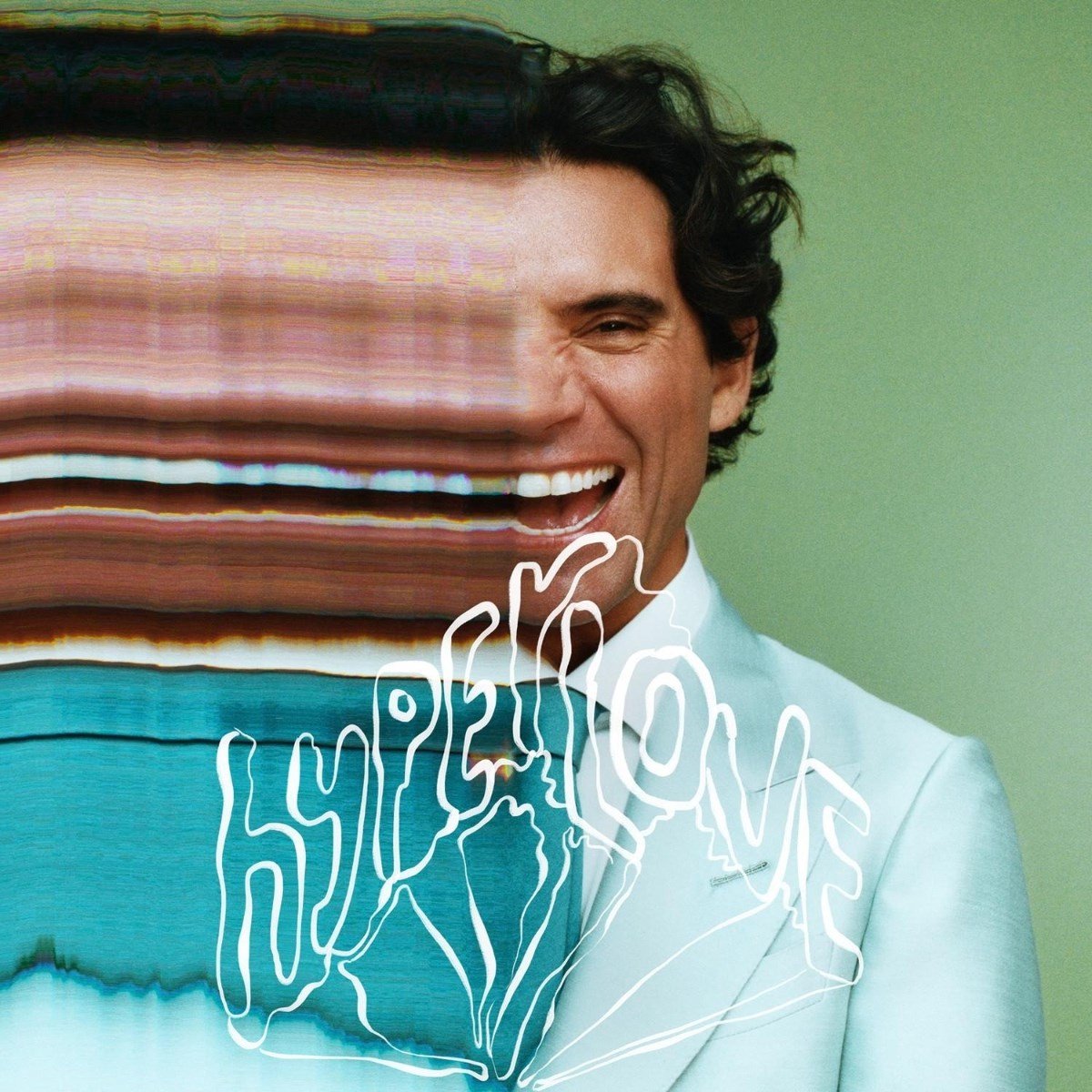
Six years is a long time in pop music. When MIKA released his last English-language album in 2019, the world looked very different. But the Lebanese-British pop provocateur has used that time wisely: he retreated to his piano, recruited some of the most experimental minds in pop, and now emerges with ‘Hyperlove’, an album that sounds like hijacking a radio station on Fire Island in the year 2126, as co-producer Nick Littlemore aptly described.
‘Hyperlove’ is MIKA’s seventh studio album and his boldest artistic statement since his multi-platinum debut in 2007. After years focusing on European markets, where hits like ‘Elle Me Dit’ dominated the French charts and TV appearances as a judge on X Factor Italia and The Voice Spain kept him in the spotlight, MIKA has orchestrated a triumphant return to his British roots. The album arrives alongside sold-out arena shows at Manchester’s AO Arena and London’s OVO Arena Wembley, his biggest headline performances to date.
The album’s creation is pure MIKA: piano compositions in a stream-of-consciousness style referencing everything from the ancient Egyptian sun god Ra to the homoerotic cinema of Italian director Pier Paolo Pasolini. Initially working alone under the free-form approach of the Royal College of Music, he captured what he calls euphoria in its rawest form. These multilayered demos were then sent to Littlemore (Empire of the Sun, PNAU), who transformed them using only vintage analogue synthesisers and outboard equipment—no digital plugins were allowed.
The production philosophy pays off immediately. The opening track and title song, ‘Hyperlove’ establishes the album’s sonic universe: warm analogue synth textures collide with MIKA’s theatrical vocals, creating an aesthetic that feels both retro and futuristic. The psychedelic edge that Littlemore brings—perhaps, as MIKA jokes, from all the psychedelics consumed—gives these songs a sparkling, almost hallucinatory quality.
Lead single ‘Modern Times’ is a perfect example of this approach. MIKA describes it as a cathedral-like cry for faith and spirit, and indeed, the song soars with religious fervour, building its chorus to euphoric heights while vintage synthesisers bubble and swirl underneath. It’s the kind of track reminiscent of MIKA’s early hits like ‘Grace Kelly’ in its unashamed theatricality but feels emotionally mature, wrestling with time, mortality, and meaning.
Throughout ‘Hyperlove’, MIKA explores what he calls the electricity between the positive and negative of a charge, the tension between our increasingly digital world and the fragility of human emotion. This theme manifests beautifully in tracks like ‘Science Fiction Lover’ and ‘Spinning Out’, where robotic precision meets deeply human vulnerability. Production choices enhance this dichotomy: every sound is crafted with vintage analogue gear, yet the overall effect feels entirely contemporary.
Adding an unexpected cinematic dimension, cult filmmaker John Waters, the pope of trash himself, provides dry narration on several spoken interludes. Waters’ unmistakable voice elevates the album’s conceptual ambitions, feeling both natural and subversive. When he reportedly told MIKA and his team that they were strange boys, it was the highest compliment imaginable.
Album closer ‘Immortal Love’ arguably serves as the emotional climax. Partly inspired by MIKA’s 15-year-old golden retriever, the track radiates warmth and nostalgia while retaining the album’s adventurous spirit. The chorus, ‘It’s just immortal love / There’s just immortal love / We are immortal love’, immediately achieves classic status, joining MIKA’s midtempo masterpieces like ‘Relax, Take It Easy’ and ‘Rain’. It’s the kind of track that feels timeless despite being entirely recorded with decades-old machines.
The album’s 15 tracks (including playful interludes) flow effortlessly, drawing listeners into MIKA’s kaleidoscopic world without overstaying their welcome. Songs like ‘Excuses for Love’, ‘Dreams’ and ‘Nicotine’ showcase MIKA’s gift for melody, the transcendent quality that made him a star nearly two decades ago. Writing collaborations with Renaud Rebillaud, Matthieu Jomphe (who has worked with Madonna and Ariana Grande) and Amy Wadge (co-writer of Ed Sheeran’s ‘Thinking Out Loud’) add varied textures without diluting MIKA’s singular vision.
If there is criticism to be made, it is that MIKA’s maximalist tendencies occasionally threaten to overwhelm. Some tracks could benefit from more breathing space amid the sonic abundance. But this is also what makes MIKA unique in an era of subdued, algorithm-optimised pop: his refusal to play it safe, his commitment to excess as an artistic statement.
‘Hyperlove’ succeeds because it embraces contrasts. It is deeply personal yet universally resonant, meticulously crafted yet spontaneous-feeling, anchored in vintage technology yet sounding wholly modern. MIKA has always been pop’s most dangerous dreamer, and this album proves his imagination is still alive and well. For fans who have followed his journey since ‘Grace Kelly’ dominated the airwaves in 2007, ‘Hyperlove’ feels like coming home. For newcomers, it’s a masterclass in how pop can be both intellectually ambitious and pure emotional release.
In 2026, as pop increasingly leans toward understated coolness and algorithmic precision, MIKA offers an alternative vision: bold, sincere, theatrical, and uncompromisingly himself. ‘Hyperlove’ is not just a comeback; it is a statement that pop music still has room for maximalist dreamers who refuse to be boxed in, or as MIKA might say, refuse to stay in the box. The analogue renaissance has a new champion, and he wears it well. (8/10) (Republic Records)


