
Precious Pop Pearls: The Story Behind Patrick Hernandez – “Born to Be Alive”
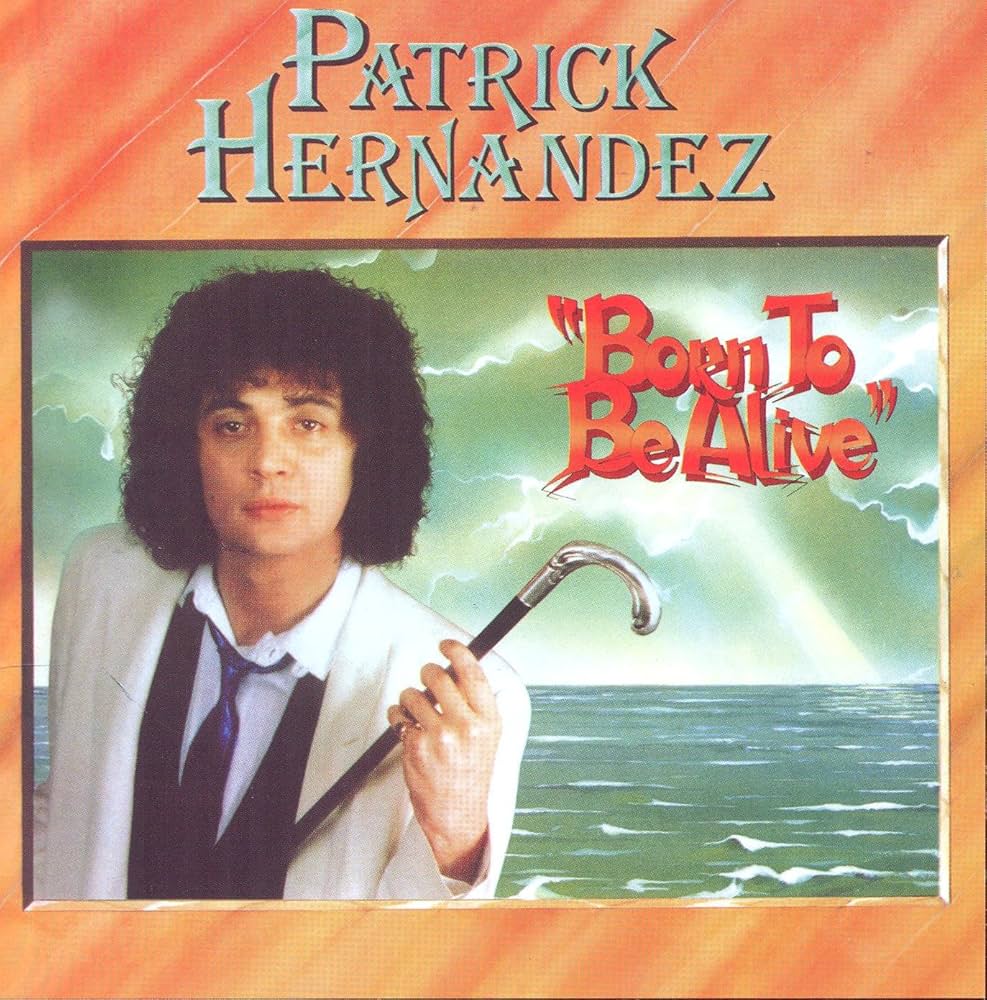
In the summer of 1979, one melody thundered through dance halls from Paris to New York, from Berlin to Sydney. An infectious disco beat with a simple yet powerful message: we were born to live. For Patrick Hernandez, “Born to Be Alive” marked both the peak and the endpoint of his career. The song became a worldwide sensation, earning 52 gold and platinum records, but it also stamped him as the ultimate one-hit wonder. Yet behind that single hit lies the story of a musician who persevered for years in the shadows, a song that was originally written as a rock track, and a striking connection with a dancer who would shortly go on to conquer the world: Madonna.
Patrick Hernandez
Patrick Pierre Hernandez was born on 6 April 1949 in Le Blanc-Mesnil, a suburb to the north-east of Paris. His background was as colourful as the music he would later create. His father was of Spanish origin, while his mother had Italian and Austrian roots. That multicultural heritage helped shape his musical identity, although Hernandez was thoroughly French in his approach and career.
The 1960s were a period of musical discovery for the young Hernandez. While The Beatles and The Rolling Stones were conquering the world, he played in local bands and toured dance halls in southern France. It was a formative apprenticeship in which he refined his craft, far from the spotlight and without any guarantee of success. In the early 1970s, Hernandez became a session musician and began collaborating with other French artists. He was part of the pop-rock trio Paris Palace Hotel, which released a self-titled album in 1975. Their single “Back to the Boogie” achieved modest chart positions in France, Germany and the Netherlands.
It was his collaboration with arranger and guitarist Hervé Tholance that proved decisive for his future career. Together, they supported established artists such as Francis Cabrel and Laurent Voulzy. Hernandez spent years working in the background, a reliable musician earning his living without ever being the centre of attention. For many, that would have been enough. For Hernandez, it became a growing frustration.
Born to Be Alive
The story of “Born to Be Alive” begins as early as 1973. Hernandez wrote the song then as an acoustic composition in the style of Bob Dylan, Leonard Cohen or Donovan, years before disco would dominate the dance floors. He had initially wanted to call it “Born to Be Wild”, but that title was already taken by Steppenwolf. With Paris Palace Hotel, he recorded a rock version in 1975, but no record label showed any interest. The song disappeared into a drawer, a forgotten attempt that seemed unlikely to get a second chance.
In 1978, the breakthrough came just as disco reached its absolute peak. Hernandez met Belgian producer Jean Vanloo, who saw potential in the French singer and offered him a contract. Hernandez travelled to Waterloo in Belgium to work on new material in the studio. He spent about a year there, working on six songs at Katy Studios. Hernandez himself was initially not a fan of disco, coming as he did from a pop and rock background. But Vanloo transformed the old acoustic song into an irresistible disco track and worked with Hernandez and guitarist Hervé Tholance on the lyrics. Where Hernandez had originally sung about running through the streets, they jokingly added the iconic ‘fine, fine, fine’, inspired by the kind of shouts you hear at beer festivals. The original energy remained, but it was now driven by a pulsating four-on-the-floor beat, shimmering synthesisers and a catchy chorus that could be repeated endlessly.
The single was released in November 1978 on the sublabel Aquarius Records. The success was immediate and overwhelming. In January 1979, Hernandez received his first gold record in Italy. The track spread like wildfire across Europe. In France, it reached number one in March, where it stayed for fifteen non-consecutive weeks between March and July. In Belgium, Austria, Germany, Spain, Denmark, Norway, Sweden and even Portugal, Italy, Mexico and New Zealand, “Born to Be Alive” topped the charts.
The United States followed with a slightly different approach. Columbia Records released a remixed version tailored to American tastes. The song reached number one on the Billboard National Disco Action chart and climbed to number 16 on the Billboard Hot 100. It remained on that chart for nineteen weeks, eleven of them in the top 40. In the United Kingdom, it peaked at number 10 and stayed in the chart for fourteen weeks. Worldwide, the single sold more than a million copies in the US alone, and by the end of 1979 the total sales had earned Hernandez no fewer than 52 gold and platinum records from more than fifty countries.
“Born to Be Alive” fitted perfectly into the transitional phase taking place in music at the time. The track had the characteristic disco energy, with its relentless beat and use of synthesisers, but it was also more accessible and pop-oriented than many other tracks of the era. Where artists such as Donna Summer with “Love to Love You Baby” and Chic with “Le Freak” delved deeper into soulful and funk-infused disco, Hernandez retained a simplicity that worked both on the dance floor and on the radio. It was not slow, sensual disco but an upbeat, exuberant ode to life itself, and that made it timeless enough to remain relevant even after the disco implosion.
The Madonna Connection
One of the most remarkable footnotes in the story of “Born to Be Alive” is its link with Madonna. When Hernandez was preparing his American tour in 1979, producer Jean Vanloo and his colleague Jean-Claude Pellerin organised auditions in New York for a group of dancers to accompany Hernandez on stage. Among the many candidates was a young, still unknown dancer: Madonna Louise Ciccone. She was 19 years old and impressed with a performance described as dazzling and marked by a strong personality.
She was selected and toured with Hernandez for several months in the summer of 1979. The producers were so impressed that they had other plans: they wanted to bring Madonna to Paris to launch a singing career. Madonna did indeed go to Paris, but after three months she returned to New York. She had other ambitions. Shortly afterwards, she formed the band The Breakfast Club with Dan Gilroy, initially playing drums. A year and a half later, she signed her first record deal. By the end of 1982, she scored her first chart entry with “Everybody”, and the rest is history. For Hernandez, it remained an anecdote, a small but fascinating crossing of careers at the moment when one had just reached its peak and the other had yet to begin.
Kelly Marie
“Born to Be Alive” has received dozens of covers by international artists over the years. The Spanish pop group Los Nikis changed the lyrics to “Me Voy a Benidorm”, a satirical reference to mass tourism in the Spanish coastal town. The Danish gothic band Nekromantix recorded a live performance that later appeared on the reissue of their 1994 album “Brought Back to Life”. Afro-Cuban singer Roberto Blanco collaborated in 2001 with the German DJ team The Disco Boys on a new version.
One of the most notable covers came in 1986 from Scottish singer Kelly Marie, who gave the song a Hi-NRG treatment. Hi-NRG was a faster, more electronic variant of disco that was especially popular in the gay club scene. Marie’s version retained the energy of the original but added a synthesiser-driven intensity that suited mid-eighties club culture. Despite the quality of the performance, the single did not chart, possibly because the world had already moved on towards synth-pop, new wave and the rise of house music. Nevertheless, the version remained a favourite in the underground scene, where the disco legacy lived on in new forms.
In 2005, the Disco Kings recorded a new version that achieved some success. The track peaked at number seven in Finland and reached modest positions in France, Austria and Germany. It proved that “Born to Be Alive” still had a recognisable power, even decades after the original release.
Disco Queen
The album “Born to Be Alive” was released internationally in 1978 and in the United States in 1979. Alongside the title track, it featured a second single, “Disco Queen”, released in the winter of 1979. The song had the same production style as “Born to Be Alive”, with a danceable groove and uptempo rhythm, but it lacked the unique immediacy of its predecessor. “Disco Queen” reached number 88 on the Billboard Dance Club Songs chart, five months after “Born to Be Alive” had dominated that list. It was a modest achievement, but at a time when disco was already losing momentum, it signalled to many that Hernandez would be unable to repeat his success.
Another track from the album, “Back to the Boogie”, was a reworking of the old Paris Palace Hotel song, now re-recorded as a danceable duet with Hervé Tholance. In its new disco incarnation, the track received more attention than the rock version ever had. It reached number 11 in France and made the top 40 in the Netherlands and Germany. It proved that Hernandez had musical talent that extended beyond a single hit, but it was not enough to pull him out of the shadow of “Born to Be Alive”.
In the United Kingdom, the B-side of “Born to Be Alive”, titled “I Give You a Rendez-Vous”, developed a life of its own. Over the years, it has amassed more than a million streams on Spotify and has become, after the title track, Hernandez’s most listened-to song. It was a slower, more romantic composition that showed Hernandez had something musically to offer beyond disco culture.
After the success of “Born to Be Alive”, Hernandez released a second album in 1980, “Crazy Day’s Mystery Night’s”, and a third in 1981, “Goodbye”. The single “Goodbye” reached the top 40 in the Belgian charts, but elsewhere commercial success failed to materialise. The shift in musical taste was unavoidable. Disco gave way to synth-pop, new wave and the early signs of house and techno. Radio stations gave less airtime to artists associated with disco, and sales figures reflected that immediately.
Hernandez was soon labelled by the media as a one-hit wonder, a term that followed him despite his further attempts to remain relevant. In 1983, he released the single “Tallulah”, which enjoyed modest success in France. In 1988, a remix of “Born to Be Alive” reached the top 20 in the Netherlands once again, proof that the song still had vitality.
Over the years, “Born to Be Alive” has remained a constant presence. The track has been used in films such as “Vegas Vacation” from 1997, starring Chevy Chase, and in “State of Play” from 2009 and “Climax” from 2018. It appeared in dance games such as the “Pump It Up” series, through which new generations discovered the song. According to estimates, “Born to Be Alive” still sells around 800,000 copies annually, often as part of compilation albums. The original version has been streamed more than 215 million times on Spotify, with a further 20 million for remixes and alternative versions. The official music video has accumulated more than 200 million views on YouTube.
Hernandez himself largely withdrew from the music industry, although he continued to perform occasionally and appeared on television programmes, especially in France. In 1999, a compilation album was released to mark the twentieth anniversary of “Born to Be Alive”, featuring both the original and the American remix. In 2012, he attended the premiere of the film “Stars 80” in Lille, a nostalgic look at the music of his generation. Patrick Hernandez may be a one-hit wonder, but that one hit has left a lasting mark on pop music.


